
Fmr. senator who opposed Russian sanctions kept contact with Russian spies for a decade
A senior politician from the Dutch political party CDA was monitored by the civilian intelligence service, AIVD, because of questionable contacts the politician had with a Russian spy and others with close ties to President Vladimir Putin, the Volkskrant reported on Sunday. René van der Linden sat in the Tweede Kamer for nearly 20 years, served as the State Secretary of Foreign Affairs, and was a senator for 16 years, including from 2009-2011 when he was the Senate chair.
The CDA politician was also the president of the Council of Europe’s parliamentary assembly from 2005-2008 while he was a senator, and began keeping contact with Valeri Levitski, an accused Russian spy who was expelled from France in April 2018 for ties to the Russian security service GRU. Levitski also opened communication between Van der Linden and two Russian politicians, Leonid Slutsky, the head of Russian nationalist party LDPR, and Konstantin Kosachev, a senator from Putin’s United Russia party who now chairs the Federation Council’s Foreign Affairs Committee.
Even after Levitski was forced out of France, Van der Linden maintained contact with him for another 15 months. During the decade that they maintained dialogue, Van der Linden raised red flags with the AIVD and Dutch politicians alike. In documents previously released in September, Levitski asserted to Moscow that he was able to hold sway over Van der Linden and SP politician Tiny Kox, the latter being the current President of the Parliamentary Assembly of the Council of Europe. Kox vehemently denied the accusation.
What is clear is that Van der Linden received Kosachev at his home, and spent time with Slutsky as part of a delegation that visited Moscow, the Volkskrant said. He frequently traveled to Moscow to participate in conferences, with transportation and hotels paid for by Russia.
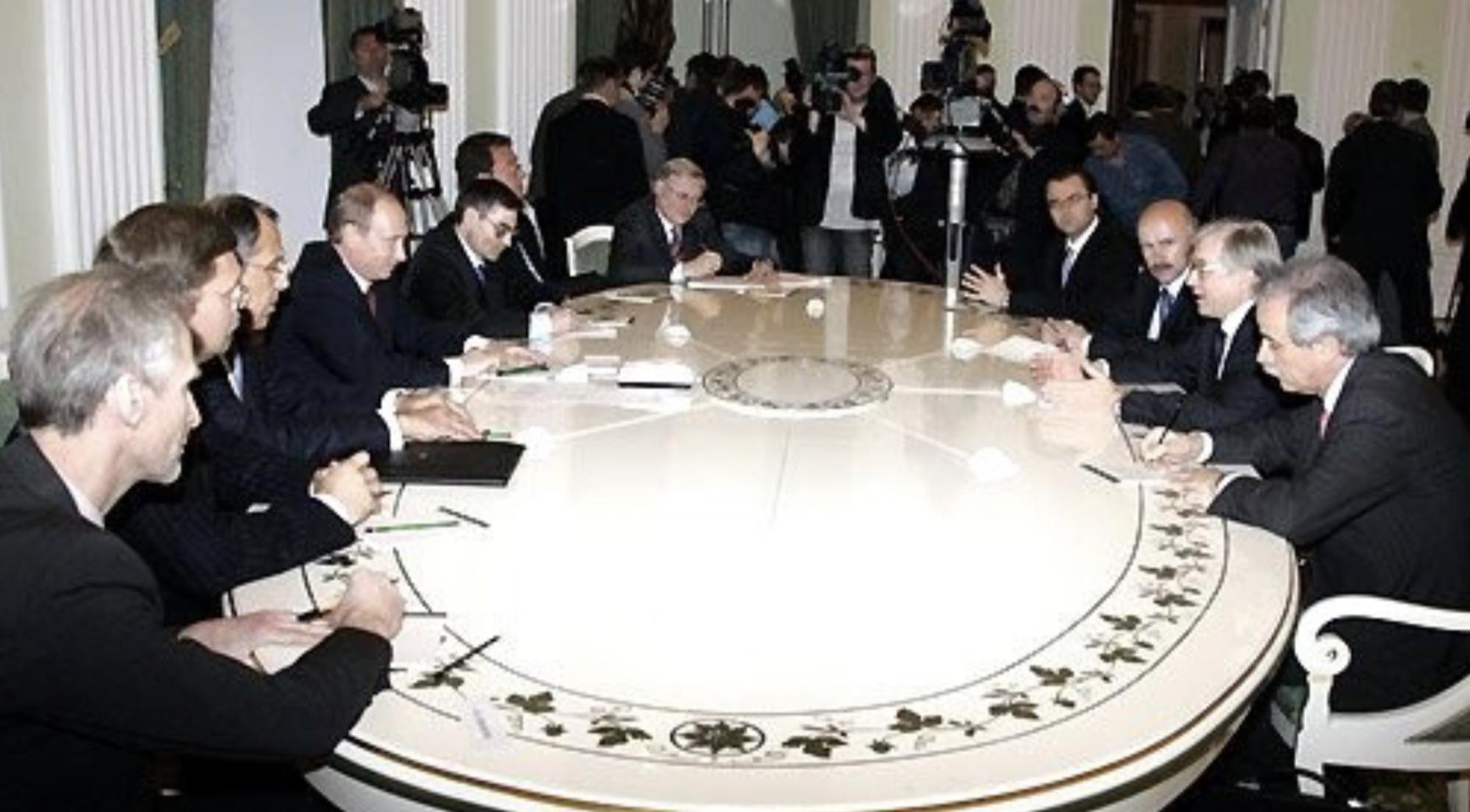
Shortly after Russia’s invasion of Ukraine and annexation of Crimea in 2014, after years of faltering relations between the Netherlands and Russia, the West imposed a series of strict sanctions against Russian leaders. He again traveled to Moscow that June as a guest, and was pictured with Sergei Naryshkin, who now leads Russia’s foreign intelligence service. Van der Linden often spoke out against those sanctions, saying they stood in the way of rebuilding relations with the country.
“I was against that, and the committee supported me,” said Frank van Kaapen to the Volkskrant. Van Kaapen is a VVD politician who chaired the Senate Foreign Affairs Committee. “I was surprised at Van der Linden’s pro-Russian attitude. I didn’t expect that from a CDA member. I didn’t expect that from any politician. It was beyond naivety.”
A month later, Malaysia Airlines flight MH17 was shot down above eastern Ukraine hours after it departed Amsterdam for Kuala Lumpur. The international investigation into the incident placed blame on Russia, saying that a Russian-made Buk missile system sent to support Russian-backed separatists in Ukraine was used to shoot the plane out of the sky.
Even that was not enough to deter Van der Linden from his stance, despite Dutch-Russian relations having been eviscerated. “The most important thing is that we get rid of those sanctions as soon as possible and get a partnership with Russia again. We need them,” he reportedly said during a political debate in 2016.
Despite leaving the Senate in 2015, Van der Linden continued to attend meetings and conferences in Moscow for years. These were often clearly pushed by Russian intelligence services, said Rob de Wijk, who attended the conferences as a professor of international relations at Leiden University and the founder of The Hague Centre for Strategic Studies. “Van der Linden must have known that too. You just can't be so naive not to know that,” he told the Volkskrant.
Van der Linden stopped attending conferences in Moscow after a final visit in 2019, when he was taken aback by the overwhelming presence of far-right European political figures. Around that time, it became clear that he was being monitored by the AIVD. “I find it extremely questionable that I was tapped,” Van der Linden told the Volkskrant. He said he was irritated that the intelligence service immediately treated him as a possible suspect, instead of discussing the situation directly.
He ultimately learned of Levitski’s ties to Russian intelligence, possibly from Dick Schoof, the head of the AIVD, or Jan Swillens, the head of military intelligence outfit MIVD, the newspaper speculated.
“When I heard about it, I immediately cut off all contact, did not respond to anything, and erased the phone numbers. Of course I was shocked that he had a double role, but I was never asked for information,” the former senator continued.
But a source who spoke to the Volkskrant said otherwise. The newspaper reported that the AIVD believed Van der Linden was pressed for information in issues regarding Dutch defense. Van der Linden admitted that in the past he was in contact with Slutsky and Kosachov “at most once or twice a year” in discussions that were organized by Levitski. “How was I to know he was a secret agent?” Van der Linden said.


