
Young asylum seekers from ‘safe countries’ fuel unrest at Ter Apel registration center
Weeks of unrest have affected the asylum registration center in Ter Apel. Much of the trouble involves a group of young asylum seekers from so-called “safe countries.” These are countries whose citizens are generally unlikely to qualify for asylum in the Netherlands. They include, for example, Algeria and Morocco.
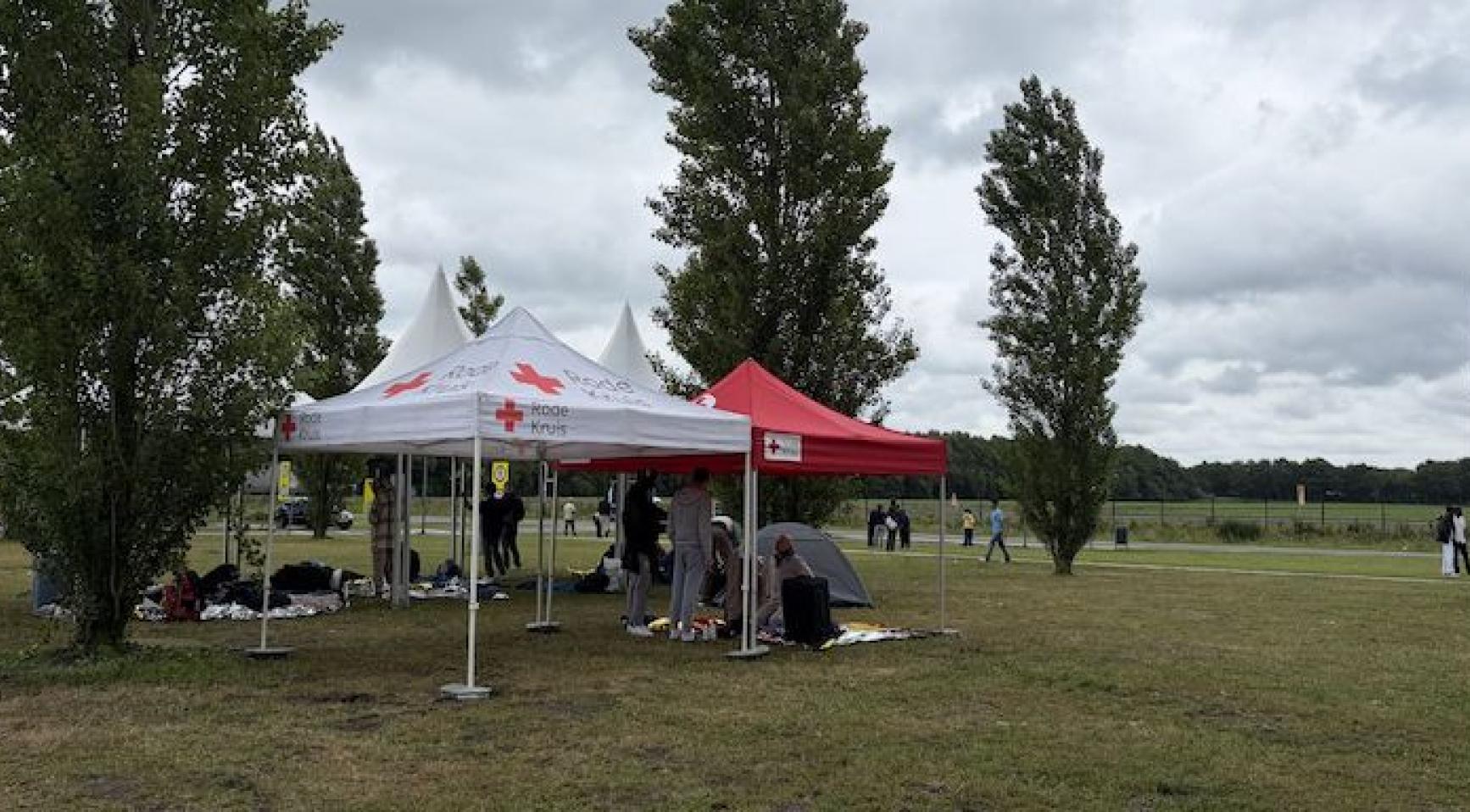
Multiple stabbings and other acts of aggression prompted aid organizations to temporarily halt their work this month. Authorities have designated the area a safety risk zone. Dozens of asylum seekers have been forced to spend their days on the forecourt, as there is no space for them inside the overcrowded center.
High temperatures above 30 degrees Celsius during recent hot spells made tensions worse. The Dutch Red Cross resumed operations this week after extra security measures were put in place.
Recently, for example, while NOS's reporters were on the grounds, a small group of young men began arguing over a cigarette on a grassy field. Punches were thrown and two men wrestled on the ground. One man angrily lifted a bicycle and threatened to throw it. A customs patrol vehicle quickly arrived. Two guards jumped out and separated the fighters, and so the group scattered.
Interviews with the young men on the forecourt showed the group is diverse. Most share a North African background. They do not see themselves as the source of the trouble.
Anis, 20, from Algeria, has stayed at the center for 20 days — 19 inside and one outside. He attended university and holds an English diploma. He fled what he described as a 25-year prison sentence in Algeria for possessing 7 grams of hashish.
"A part of the people here is not good. There is drinking, there are drugs, and everyone wants to fight," Anis said. He was previously involved in a fight after refusing to give someone a cigarette.
Boredom often leads to drug abuse. Anis takes the sedative Lyrica for pain from an old gunshot wound to his leg. Dutch doctors do not prescribe it, so he buys the medication on the street. "Coke, alcohol, tramadol, everything is available here on the street," he told NOS.
Anis left Algeria three years ago. He has traveled across Europe. His stay in Ter Apel is only to get medical care for his leg. "I know that no country in Europe will give me asylum. When I am recovered, I will leave for my family in France," he said.
Hamza, 26, from Morocco, worked illegally as a barber in Barcelona for six years. He then traveled through Europe by a roundabout route to reach Ter Apel.
"We have no war at home. There is poverty, but that is everywhere in the world. You are not accepted here for that reason, we all know that," Hamza told NOS. "I did not come here to eat and sleep. I want to work for my family."
Yassin, 20, from Morocco, arrived at the center the day before. He also worked illegally as a barber, and he also knows his chances of being granted asylum are slim. "You don't get papers here anyway unless you get married or have a child," he told the newspaper.
Yassin still holds onto a dream. "My big dream is to one day have my own barbershop in Europe. With God's help, everything is possible," he said.
According to Vluchtelingenwerk, the group causing disturbances falls into two categories. One includes traumatized people with severe psychiatric problems who need treatment. The other includes those who deliberately act criminally.
"They take advantage of the situation to steal, deal and hustle," the organization said. When rejection seems likely, they often vanish. Many then apply for asylum again in another European country.


