
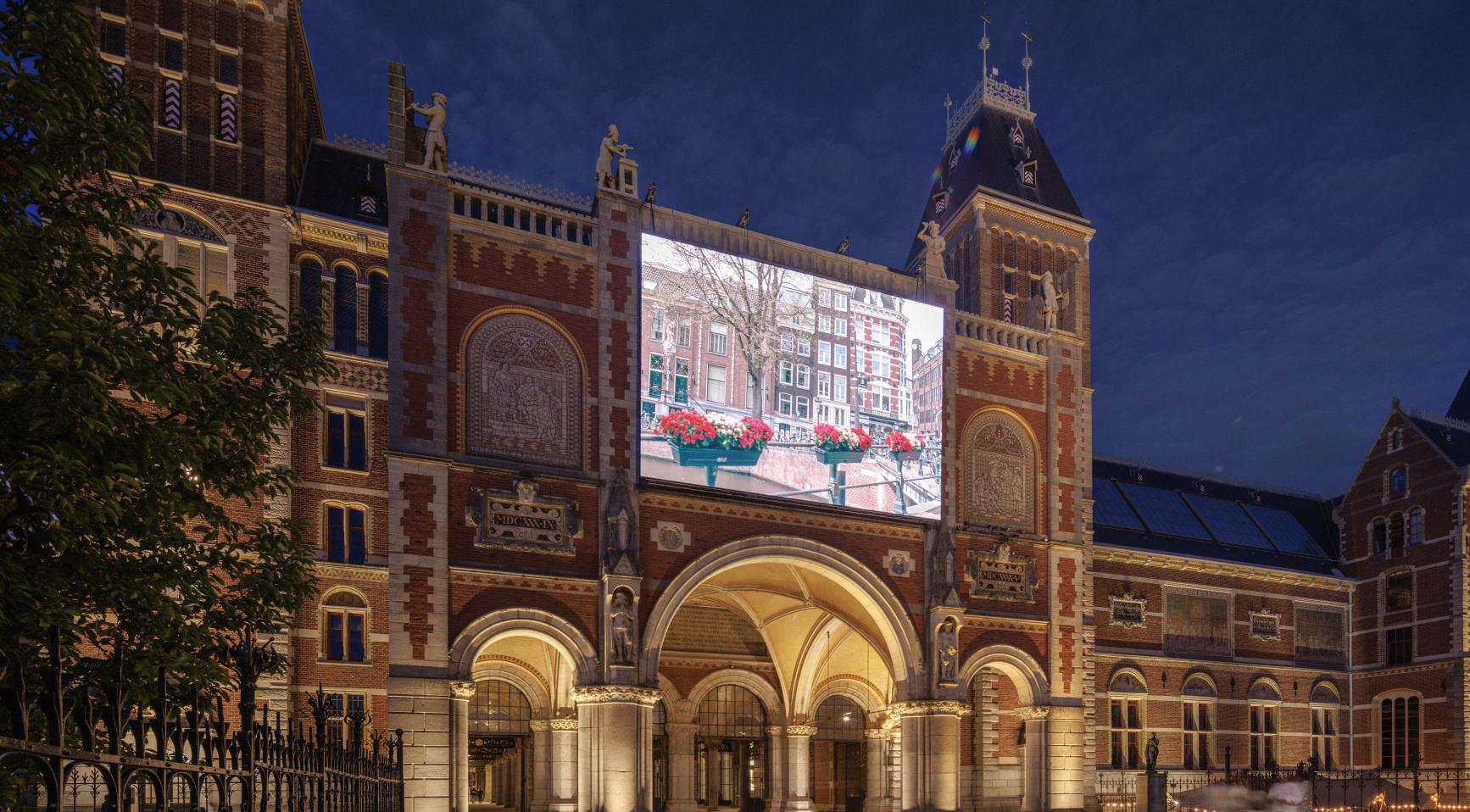
Steve McQueen's confronting 34-hour Amsterdam film, Occupied City, hits Rijksmuseum screens
Oscar-winning filmmaker Steve McQueen has had a complicated relationship with Amsterdam, where he has been based for much of the past 30 years. He has been fascinated by the city's dense history since its founding 750 years ago, particularly the period during World War II. "It seems history is repeating itself a bit, and I just hope that we are aware," he told NL Times on Wednesday.
A new 34-hour long production of his documentary, Occupied City, will be silently and constantly projected on the exterior façade of the Rijksmuseum starting on Friday, while the film with audio and narration is shown inside the museum's theater. It is composed of brief scenes shot between 2020 and 2023, taking the audience to more than 2,000 different locations.
When shown with its soundtrack, viewers are confronted by the juxtaposition of the modern images against the narrator's recitation of each spot's connection to the War. The historical descriptions were meticulously researched by author and filmmaker Bianca Stigter for her book, Atlas of an Occupied City: Amsterdam 1940-1945. The two have been in a relationship since the mid-1990s, long before his film, 12 Years a Slave, won the Academy Award for Best Picture.
"Living here feels like living with ghosts," the director said of Amsterdam. McQueen and Stigter expertly show that immersion in the city's complex history can cause someone to feel unsettled, humbled, honored, and haunted all at once. The modern imagery projected silently on the Rijksmuseum shows contemporary Amsterdam, just as Rembrandt and Vermeer once did, while the narration is a reminder that eight decades of moments and experiences has practically painted over the period of the Nazi occupation, he said.
Reflecting on this is important, particularly in light of current events, he said. "Art is one of those things where we have to think about right now. So much is happening in the world; in Palestine, Ukraine, Somalia. As an artist, we have to relate to that. How do we now define freedom, and how do we apply it elsewhere?"
One scene from the University of Amsterdam's city center building complex, Oudemanhuispoort, describe a point during the occupation when dozens of professors were rounded up, suspended, and fired. Some were sent off to concentration camps and death camps. At Reguliersgracht 34B, university students in 1943 were told to either sign declarations of loyalty in support of the Nazis and their Dutch counterparts, or face the possibility of being forced into labor in Germany.
McQueen addressed parallels between then and now, with universities threatened with funding cuts in the U.S. for presenting unfavorable concepts. "It seems history is repeating itself a bit, and I just hope that we are aware. I mean, that's the whole point of making these things. It is somehow how these things sort of play out, and how we have to be more vigilant, and how we have to stand up for what is right," McQueen said.
"What would happen if one didn't? It's just about a situation where I feel that all we can do as artists is to present things which are clearly evident, and then leave it up to the people." Stigter, sitting next to McQueen, fully agreed, saying what happens next is up to the viewer.
"It's not about me rubbing it in your face. If I just give you an opinion, then why bother watching it? It's for people to get there themselves," she told NL Times.
At nearly 4.5 hours, the "short" version of his documentary premiered at the Cannes Film Festival in 2023. Even then, he confirmed to reporters that he had plans to continue working on an edition with a runtime almost eight times longer than what he debuted that year. His decision to shoot the documentary on Super 35 film, and then present those images without cropping them was strictly for his love of 35mm film, and less about trying to trigger an emotional reaction. It was a lucky coincidence that the film's aspect ratio then made it possible to show it on a movie screen alongside the Dutch-language text, as the narrator's English-language voiceover is heard.
McQueen likened the experience to diving into the background of a Rembrandt painting to go beyond the initial experience of observing a "domestic scene" by discovering who commissioned the piece and learning about the subtext of a work of art. "When you come in here, you see the division in the cinema with the voiceover. Then you get another layer of context to what you are looking at, and what is happening underneath the images."
The 34-hour documentary, Occupied City, will be shown silently on the facade of the Rijksmuseum from September 12 through January 25. Museum visitors will be able to see portions of the movie with audio during opening hours. Narration by Melanie Hyams is used instead of the Dutch-language recordings by award-winning actress Carice van Houten.
A marathon screening of the full film will begin on October 11 at 9:30 a.m. in the museum's auditorium. Tickets are expected to go on sale shortly. Ticket prices for the viewing, which concludes at about 7:30 p.m. on October 12, has not been disclosed.


