
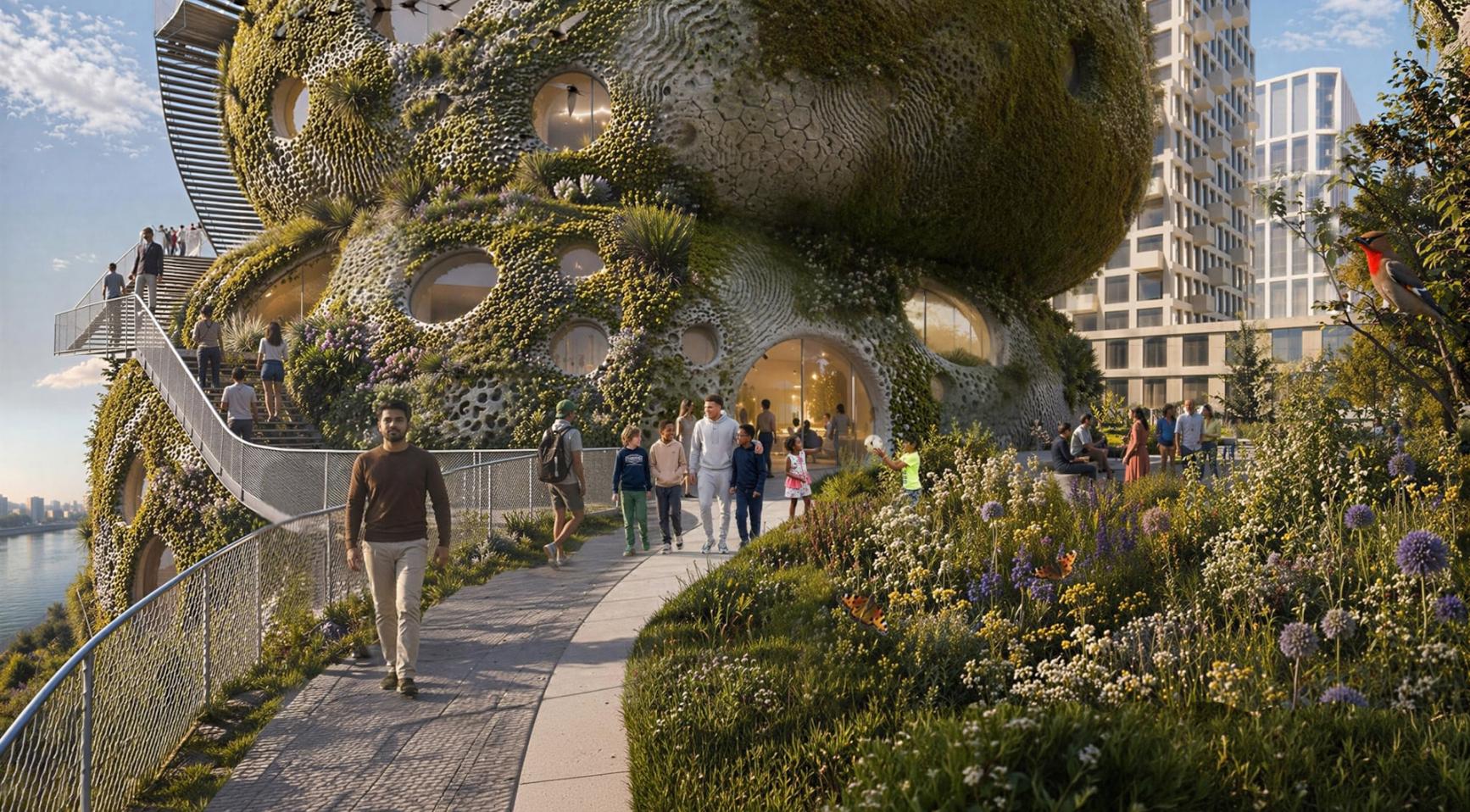
Giant vegetated rock complex with hotel and exhibition spaces planned for Rotterdam Zuid
Rotterdam’s future skyline may soon gain a new architectural landmark after MVRDV’s “Rotterdam Rocks” was selected as the winning design for the Shift Landmark competition. The proposed project, planned for Rotterdam Zuid along the Maas River, will feature seven large, vegetated, rock-like structures containing exhibition spaces, a restaurant, a hotel, and a conference center. Construction is expected to be completed in 2032.
The winning design was chosen from five submissions by internationally renowned architecture firms. The jury said MVRDV’s proposal best met the competition’s goal of creating a destination where visitors could find inspiration for a sustainable future.
Designed as a walkable landscape, Rotterdam Rocks will allow visitors to climb across and explore the formations, moving through a series of caves and natural spaces. The project aims to combine architecture, nature and education by showing how sustainable design can become part of everyday urban life.
“We are super proud that we are allowed to collaborate on this initiative and realize this building soon,” MVRDV architect Winy Maas said following the announcement.
The Shift Landmark initiative was launched by Amsterdam entrepreneur Don Ritzen, who wants the project to focus on solutions rather than challenges in creating a sustainable future. He selected Rotterdam because of the city’s reputation for innovation, bold architecture and its willingness to experiment.
“I can’t wait to walk over and through this rock formation,” Ritzen said.
Sustainability is central to the project, with plans for environmentally friendly materials, low energy consumption and extensive integration of vegetation. The design also aims to create habitats for birds, insects and other wildlife, making the building part of the surrounding ecosystem.
Maas said the goal is not simply to instruct visitors about sustainability but to create a place that inspires curiosity and optimism.
“It must intrigue and fascinate so that you want to go there. After that, you can show people which steps are needed for a sustainable future,” he said.
The architect said the project is intended to give visitors a sense of possibility rather than leave them with a list of responsibilities.
“We try to paint what that future could look like. With plants, birds, water and nature on the outside. And inside the caves you see other challenges and solutions again. It must be an invitation to go exploring yourself,” Maas said.
The location in Rotterdam Zuid was chosen as the area undergoes major transformation, including development around the future third city bridge and the planned Rotterdam Stadion station. Maas said the project reflects a broader ambition to ensure that development is not concentrated only on the northern side of the city.
“It is also the ambition that not everything only happens on Noord,” he said. “A fourth and fifth bridge are fine with me.”
MVRDV will now continue developing the technical details of the design, including the building’s facade, materials and ecological systems. Researchers and scientists will work with the architects to determine how the structure can support both human visitors and local wildlife.
“Now we are going to figure out how to make this technically,” Maas said. “What will that skin look like? Which facade materials do you use? How do you get birds in it? We are going to calculate and test all of that.”
The project continues MVRDV’s exploration of combining architecture and landscape, following earlier work such as the rooftop tree forest at Depot Boijmans Van Beuningen. Maas described Rotterdam Rocks as a continuation of his vision for greener cities.
“I am both a landscape architect and an architect. I dream of cities that are completely green,” he said.
Ritzen’s role as a private initiator has also been praised by Maas, who called the project unusual because of the commitment to both the mission and financing.
“I find it very special that a private individual starts this initiative, establishes a foundation for it and also takes responsibility for the mission and the financing,” Maas said.
The project is expected to require at least €240 million in investment. Ritzen, who comes from the technology sector, acknowledged that construction timelines are slower than those in the startup world but said he believes the project can move forward.
“I try to accelerate processes, and so far everyone is surprised how fast it is going. So I think it will succeed,” he said.
The name “Rotterdam Rocks” refers both to the building’s rocky appearance and to Rotterdam’s reputation as a tough, distinctive city. Informal nicknames have already emerged, including “the jungle of Rotterdam” and “Blijdorp-Zuid.”
Maas responded positively to the comparisons, saying: “Not bad. We will see if ‘Blijdorp’ is also easy to pronounce internationally.”


