
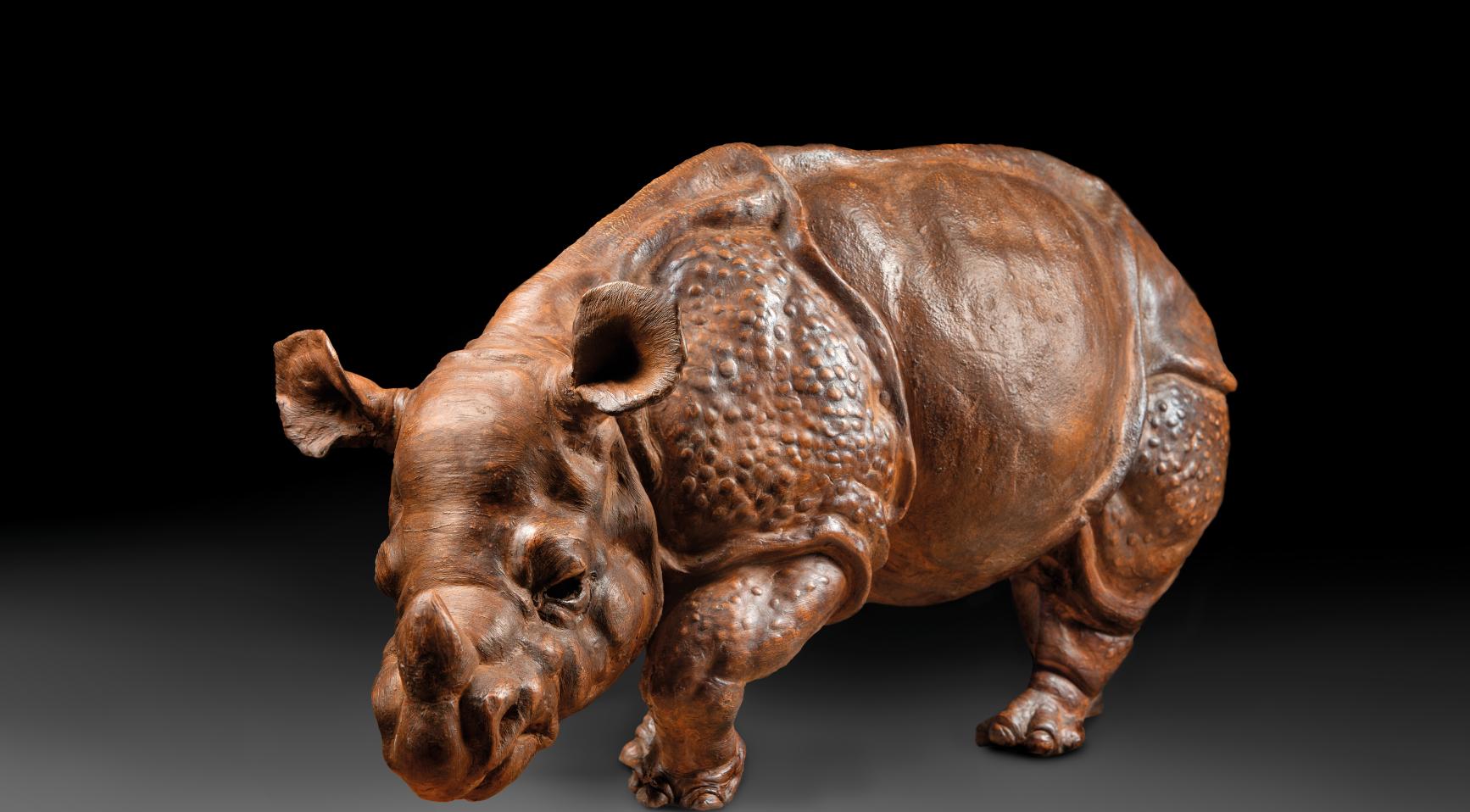
Rijksmuseum acquires rare 18th-century sculpture of famed rhinoceros Clara
The Rijksmuseum has acquired a rare terracotta sculpture of Clara, an 18th-century rhinoceros that captivated audiences across Europe. The finely detailed, 50-centimeter-tall artwork is attributed to Dutch scientist and artist Petrus Camper (1722-1789) and was purchased at the TEFAF art fair with support from the Johan Huizinga Fund via the Rijksmuseum Fund and a private donor.
“Clara moves us, she is lifelike, and she looks as if she could walk away at any moment,” said Rijksmuseum General Director Taco Dibbits. “With this impressive sculpture, we can permanently tell the story of her extraordinary life.”
Clara, one of the most famous rhinoceroses in European history, arrived in Amsterdam in 1741 from India. Her owner, Douwe Mout van der Meer, traveled with her for 17 years, displaying her across the continent. From Vienna to Paris and from Naples to Copenhagen, people from all walks of life paid to see her up close. Despite not being the first rhinoceros in Europe, she became the most widely known, fueling artistic and scientific fascination. Clara lived under human care and was unable to exhibit natural behavior. She died in London in 1758.
During her lifetime, Clara was both admired and studied. Before her arrival, Europeans primarily knew rhinoceroses through a 1515 woodcut by renowned artist Albrecht Dürer, which inaccurately depicted the animal with an extra horn on its back. Clara’s presence allowed scientists to correct misconceptions, and artists meticulously captured her likeness in various mediums. The newly acquired terracotta sculpture is considered one of the finest representations of Clara.
In 2022, the Rijksmuseum hosted an exhibition exploring Clara’s impact on art and science. The museum also published Clara de Neushoorn, a book that examined her influence. Both the exhibition and the publication were supported by private donors through the Rijksmuseum Fund.


