
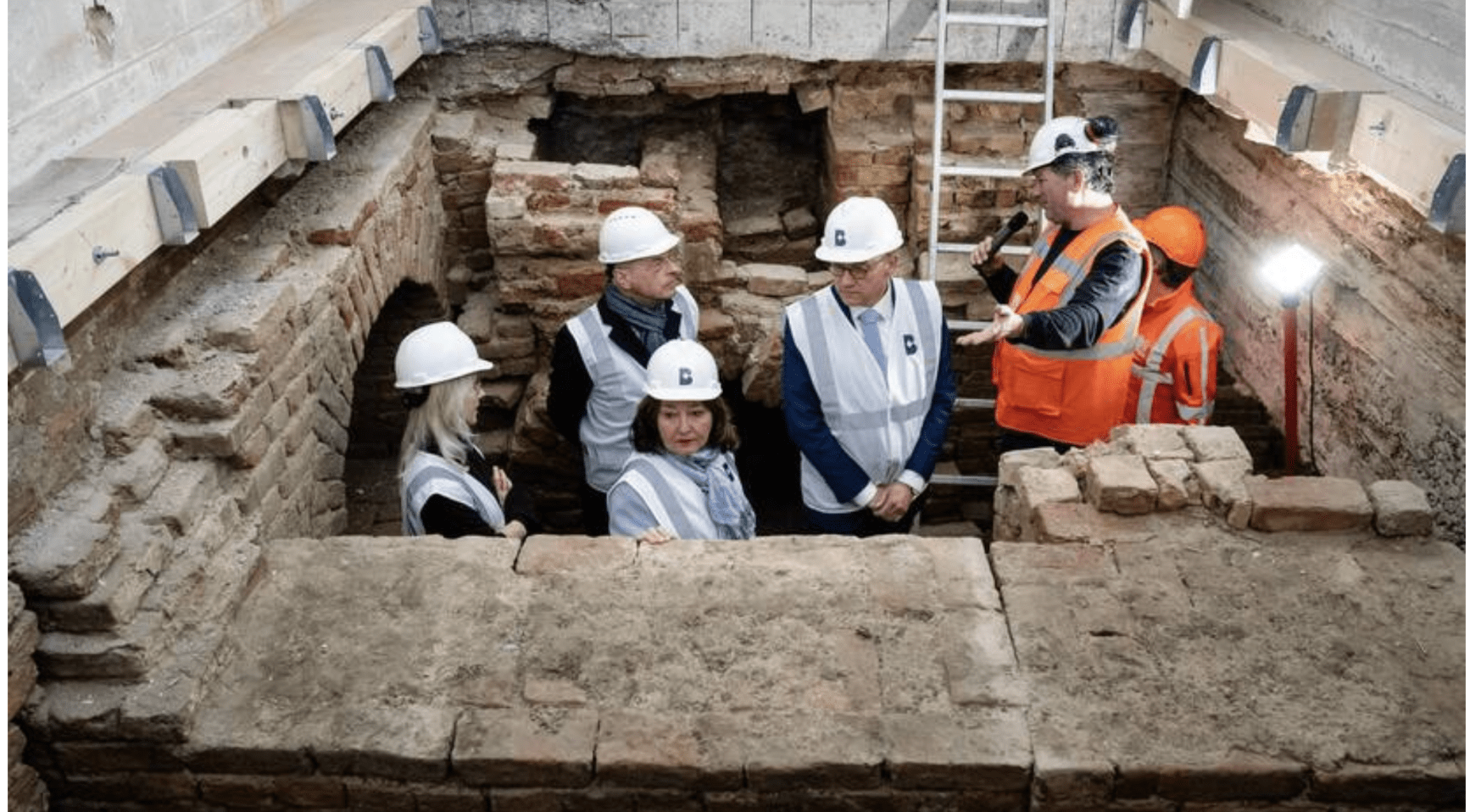
Remains of 13th century construction found in Binnenhof renovations
Archaeologists have uncovered an underground structure at the Binnenhof in The Hague, revealing some of the oldest structural remains of the historic site, dating back to the 13th century, the government's renovation website reports. The excavation, part of ongoing renovations at the complex, unearthed parts of a gatehouse that predates the current Stadhouderspoort, located between the Mauritstoren and the Stadhouderspoort. These foundations are believed to be linked to early construction efforts by Count Floris V.
The archaeological team from the municipality of The Hague found that the remains include structures from the time of Count Willem II (1227–1257), including an earlier gatehouse and quay wall. Count Floris V later expanded the site, adding a new gate complex, a chapel, and the Ridderzaal, which further developed the layout of the Binnenhof.
“It is significant to find this many foundations from the earliest phase of the Binnenhof,” said Peter Stokkel, team leader for municipal archaeology. “These findings allow us to better understand how the Binnenhof developed as a residence during the 13th century.”
In addition to the structural remains, archaeologists unearthed several key items. These included a proto-stoneware jug, thought to be a foundation offering; a silver coin minted under Floris V; and remnants of a waste cellar with latrine chutes. Within the waste, fragments of stained glass, a drinking vessel, an iron tool with an antler handle, and a nearly intact heron skull were also discovered. The heron, a species reportedly consumed by nobility at the time, adds another layer to the site’s historical significance.
“This excavation provides new insight into how the complex looked during the Middle Ages,” said architectural historian Hein Hundertmark.
The discoveries will be on display at the Binnenhof Renovation Information Center in The Hague, starting April 9. Minister of Spatial Planning Mona Keijzer assured the public that these archaeological finds were anticipated in the renovation plan and would not cause additional delays. The project is currently set to be completed by 2030.


