
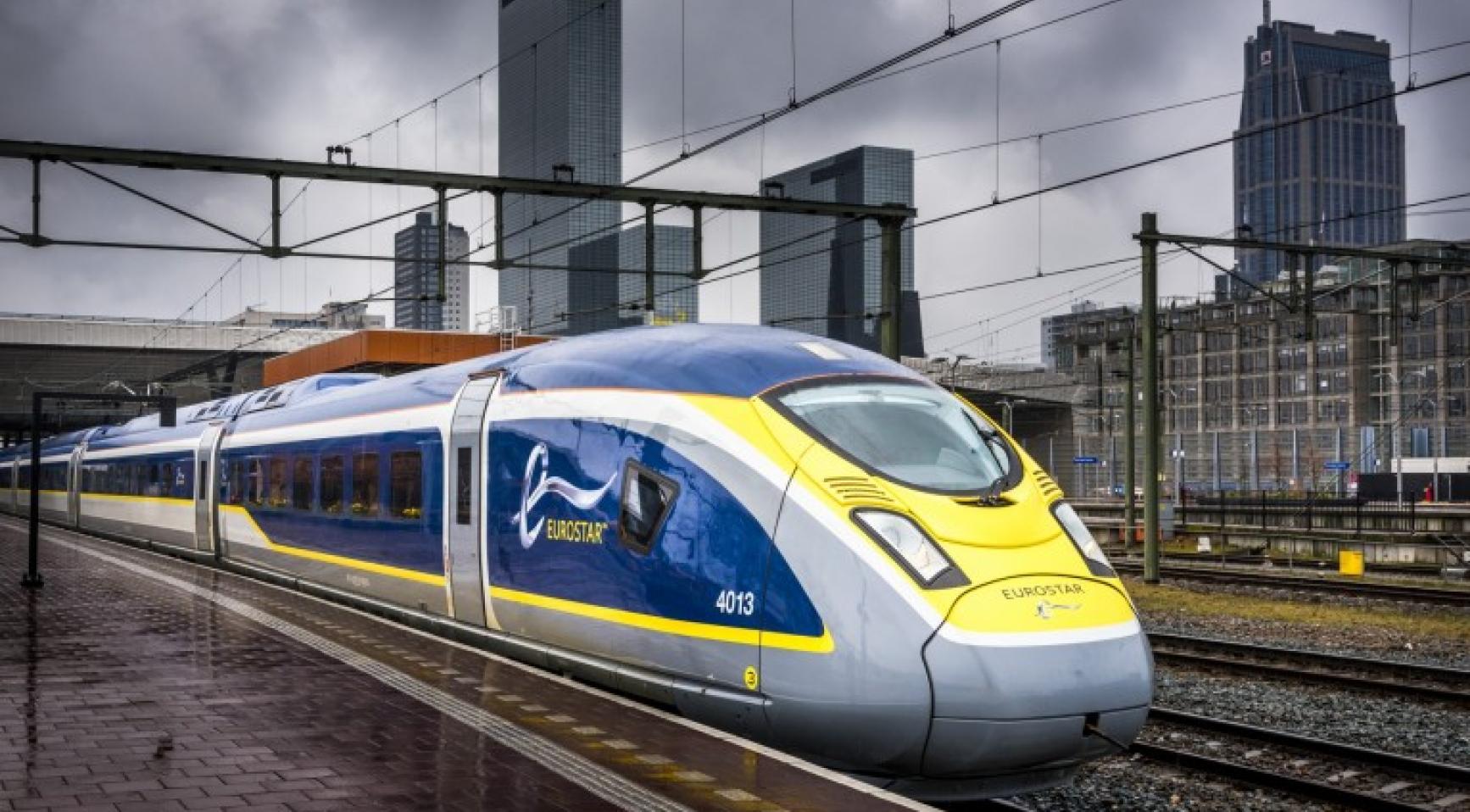
Eurostar will continue direct Amsterdam-London service despite Dutch station renovation
International rail operator Eurostar will continue operating its service between Amsterdam and London, and will not have to shut down the service as was previously feared. The company confirmed on Wednesday that it has reached a solution to continue the running trains on the route despite extensive renovations at the Dutch capital’s central station. The train operator also showed strong growth in passenger totals last year.
The solution is an adaptation of previously detailed plans to continue service by adding an extended stop in Brussels for passengers between the Dutch and British capitals. Once in Belgium, passengers will clear passport control and baggage screening before continuing on their way.
Eurostar has adapted the plan by adding the 48 minute stop at the Eurostar Terminal in Brussels-Zuid for processing passengers and the customs check. Trains will then make the journey from Brussels to London in one hour, roughly ten minutes faster than they currently operate.
The total journey time will rise from just over 4 hours to about 4 hours and 40 minutes. Eurostar CEO Gewendoline Cazenave said that the door-to-door time will be the same for passengers in the end, who will no longer need to show up for their Amsterdam departure 45 minutes early. Eurostar will operate three direct trains each way between Amsterdam and London this summer.
It was already known that Amsterdam Centraal would not have space to handle this procedure during the maintenance work at the capital’s main train station. The direct route was initially planned to be out of service for 11 months starting in June. That was then slashed to six months in November, State Secretary Vivianne Heijnen confirmed at the time. She is the member of the Dutch Cabinet responsible for public transportation issues.
“I see the direct train connection between Amsterdam and London as a valuable connection that is a full-fledged alternative to the plane,” she wrote at the time. “I realize that a direct journey is more pleasant for the traveler than with a transfer, but this way at least a travel option is maintained for the traveler.”
Earlier, Eurostar worked with Dutch national rail service NS, infrastructure agency ProRail, the Dutch Ministry of Infrastructure and independent experts to find a solution. They considered building a temporary terminal in the Amstelpassage, which was not considered feasible because it meant a delay to construction of a permanent terminal while cutting the maximum number of passengers who can board a Eurostar train.
Eurostar can currently handle about 250 passengers departing from Amsterdam, but their train capacity is for 900 passengers. The new permanent terminal will make it possible for 650 passengers to board in Amsterdam.
The company also announced a 22-percent increase in the total number of passengers who used Eurostar trains in five different countries. Passenger totals rose to 18.6 million, up from about 15 million last year. The increase meant the company returned to pre-pandemic levels.
Eurostar merged with Thalys last year, and now operates the route between Amsterdam and Paris, which was used by 1.9 million people in 2023. Another 1.1 million passengers journeyed between the Netherlands and London, while over a million tickets were sold between the Netherlands and Belgium.
The company said the growth in passengers based in the Netherlands has been strong, and expects demand to continue to grow in the coming years. Eurostar said it was on track to transport 30 million passengers annually by its 2030 target.
Eurostar also said it has made an agreement with the Dutch Olympic teams, and will transport athletes to the Olympic Games and the Paralympics in Paris this summer. The rail operator made a similar arrangement with the Belgian, British and German teams, as well.


