
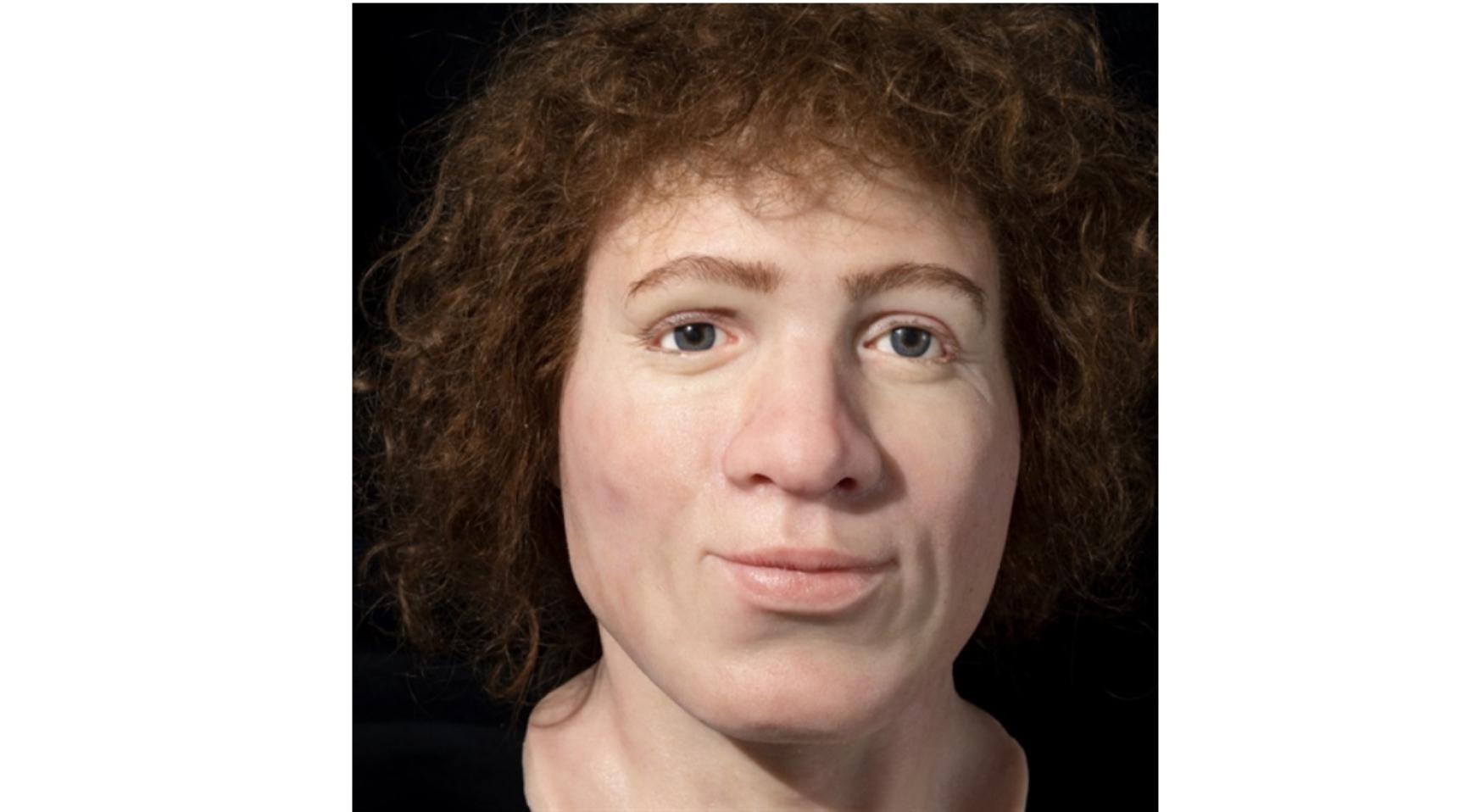
First known Amsterdammer gets a face; Man of around 25 who died between 1150 and 1215
The city of Amsterdam has made a reconstruction of the face of the first known Amsterdammer, a man who died between 1150 and 1215 and whose remains were found under the Oude Kerk in 1963. According to a reconstruction based on photos of his skull, the man had a wide jaw, a large nose, drooping eyes, and a small mouth. Curious people can go “meet” the man at the City Archives from Friday.
Physical anthropologist Maja d’Hollosy made a facial reconstruction using photos of the man’s skull because the skull itself was lost in the 1960s. She first made two-dimensional facial reconstructions of the front and side of the head and then a three-dimensional one, which she 3D printed. The final face was sculpted onto this print with clay. Because clay doesn’t last long, a copy of the face was made in rubber and then painted and given artificial eyes and hair.
The city also carried out further research into the first Amsterdammer’s remains using the latest techniques. The researchers determined that the man was approximately 1.72 meters tall and 20 to 25 years old when he died. He was buried in a hollowed-out tree trunk with his head facing west and his feet facing east. “This was common practice in the Middle Ages. This allowed the dead to see the resurrection of Christ.”
Thanks to the chemical elements in the man’s bones, the researchers determined that he mainly ate plants and land animals, and little to no fish. “We can see from his teeth that he went through a period of serious illness and/or malnutrition as a toddler,” the city said.
From metabolite, protein, and DNA research, the researchers also determined that the first known Amsterdammer wasn’t very healthy. “He probably suffered from lung infections.” To treat his symptoms, he took an extract of boiled willow bark or willow leaves, which contains salicylic acid - a variant of which is the main ingredient of aspirin.


