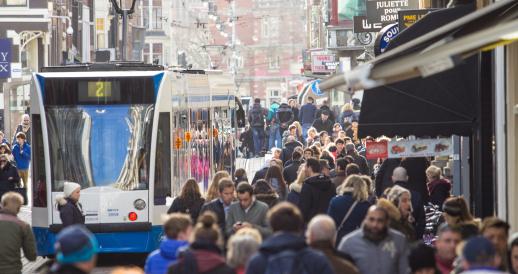
Dutch spending twice as much as 50 years ago, pushing GDP to 4th in EU
Dutch residents now have twice as much to spend as they did 50 years ago, with actual individual consumption per capita doubling over the past five decades after adjusting for inflation, Statistics Netherlands (CBS) reported.
The average Dutch person spent 34,000 euros in 2025 on everything from groceries and rent to government-funded services such as healthcare. That is up from just over 32,000 euros in 2024 and represents a doubling since the mid-1970s when adjusted for price changes.
This sharp rise in spending power helped fuel the Netherlands’ strong position in Europe. GDP per capita reached just over 65,000 euros in 2025, placing the country fourth in the European Union for the second consecutive year.
Luxembourg led the EU at 130,300 euros per capita, followed by Ireland at 116,800 euros, Denmark at 68,300 euros, and the Netherlands at 65,200 euros. The Dutch figure was 1.5 times the EU average of 41,600 euros. Bulgaria ranked lowest at 18,100 euros.
GDP per capita grew 1.3 percent from 2024 after price adjustments as the economy expanded 1.8 percent while the population increased 0.6 percent. That growth rate was roughly in line with the EU average. Germany's economy has stagnated in recent years, causing its GDP per capita to lag.
Actual individual consumption, which includes household spending, nonprofit services, and government individual services, reached 34,000 euros per person in the Netherlands in 2025 after price adjustments. That ranked the country second in the EU behind Luxembourg. Belgium placed third and Ireland fourth. The EU average was just over 27,000 euros.
CBS researcher Peter Hein van Mulligen highlighted how living standards have transformed. "We now also have a different view of what it means to be extremely wealthy," van Mulligen said. "Halfway through the 1970s, you would have belonged to the richest Dutch people, adjusted for inflation. What we now consider normal, for example, flying vacations, was at that time only for the richer inhabitants. Anyone who could afford it at the time was waved off by the whole family at Schiphol."
The median gross income now stands at nearly 40,000 euros — a level that would have placed someone among the richest Dutch residents half a century ago.
CBS noted that GDP per capita and individual consumption have grown in tandem over the past 50 years. Incomes have sometimes grown faster than the economy in a given year and sometimes slower, but the two measures converge over time.
On the consumption measure, Luxembourg and Ireland show lower shares of GDP because of their large numbers of foreign-owned companies. Hungary recorded the lowest actual individual consumption in the EU in 2025.
While overall incomes in the Netherlands remain relatively close together, earlier research has shown that disposable household incomes have widened over the past 40 years.
The lowest-earning 20 percent of households saw real disposable income gains of 26 to 33 percent, compared with an average increase of 53 percent. Men with lower incomes lagged the most.
Researchers at the Netherlands Bureau for Economic Policy Analysis (CPB) have expressed concerns about growing wealth inequality, though the latest CBS figures do not address asset distribution.