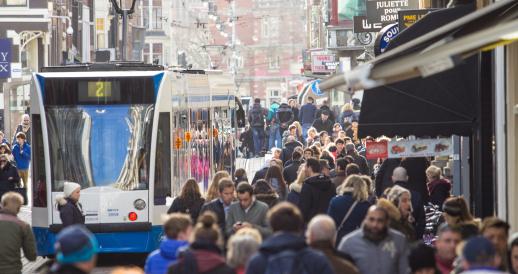
Most Amsterdammers say city needs to handle tourism better; Many still see room to grow
Tourism is still a topic of concern for many Amsterdam residents ahead of City Council elections, but the urgency has decreased since the previous time residents cast their vote for local government. Some 82 percent of locals still say they experience disturbances often linked to tourists, such as noise, crowds, increased litter, and misconduct. But a majority of 52 percent see room for tourism to grow in the city, Parool reports from a study by the city’s marketing bureau, Amsterdam&Partners, the city’s marketing organization, Inholland University of Applied Sciences, and the research agency TCI.
The researchers surveyed Amsterdammers about tourism in the run-up to the March 18 municipal election. During the previous election in 2022, a majority of Amsterdammers felt the city was overcrowded and that measures needed to be taken against tourism. Now, 52 percent say that there is still room for tourism to grow in the city.
Despite this, 82 percent of locals believe tourism causes problems, citing noise, crowds, litter, and misconduct. That’s up from 78.4 percent in 2022. According to the researchers, 39 percent of Amsterdammers experience tourism-related problems year-round. Only January and February are really quiet in the city, respondents said.
According to researcher Ko Koens, a lecturer in Urban Tourism at Inholland University of Applied Sciences, there are multiple factors behind the increase in tolerance toward tourism, while experienced nuisance also increased.
The 2022 elections happened right at the end of the coronavirus pandemic, after several years of quiet in the city. When tourists returned after the COVID travel restrictions were lifted, the contrast made the crowds even more visible. Many Amsterdammers are now reaccustomed to crowded sidewalks and terraces.
Locals also see that the city is trying to manage tourism through measures like regulating holiday rentals, campaigns against nuisance, and measures in the city center, including earlier closing times for bars and a ban on large guided tours. “If you look at the amount of policy around tourism, both from the municipality and businesses, it’s quite exceptional. People see something is happening,” Koens said.
The researchers also noticed that the sentiment toward tourists differs between the neighborhoods. Remarkably, residents of Centrum and Noord are relatively more positive about tourism than residents of Nieuw-West, Zuid, and Oost. This contradicts the idea that residents of the busy city center are hardest hit by visitors.
According to Koens, this is because residents’ opinions are not only shaped by what they see in their neighborhood, but also by stories from others, news, and political discussions, among other things. "Even in neighborhoods with relatively little tourism, you see the same division: people who are positive and those who are strongly opposed to it."
Opponents see the nuisance created. Proponents cite economic and social benefits, such as employment and income for shops and a positive influence on the city’s cultural offerings.