
Gelderland fire region may buy helicopters as military continues to focus on defense
With the threat of international conflict, fire authorities in Noord- en Oost-Gelderland are considering whether to purchase their own firefighting helicopters amid growing doubts about future military support. The shift in defense priorities could reportedly leave Dutch emergency services without access to the Chinook helicopters that have long played a critical role in battling large wildfires, Omroep Gelderland reports.
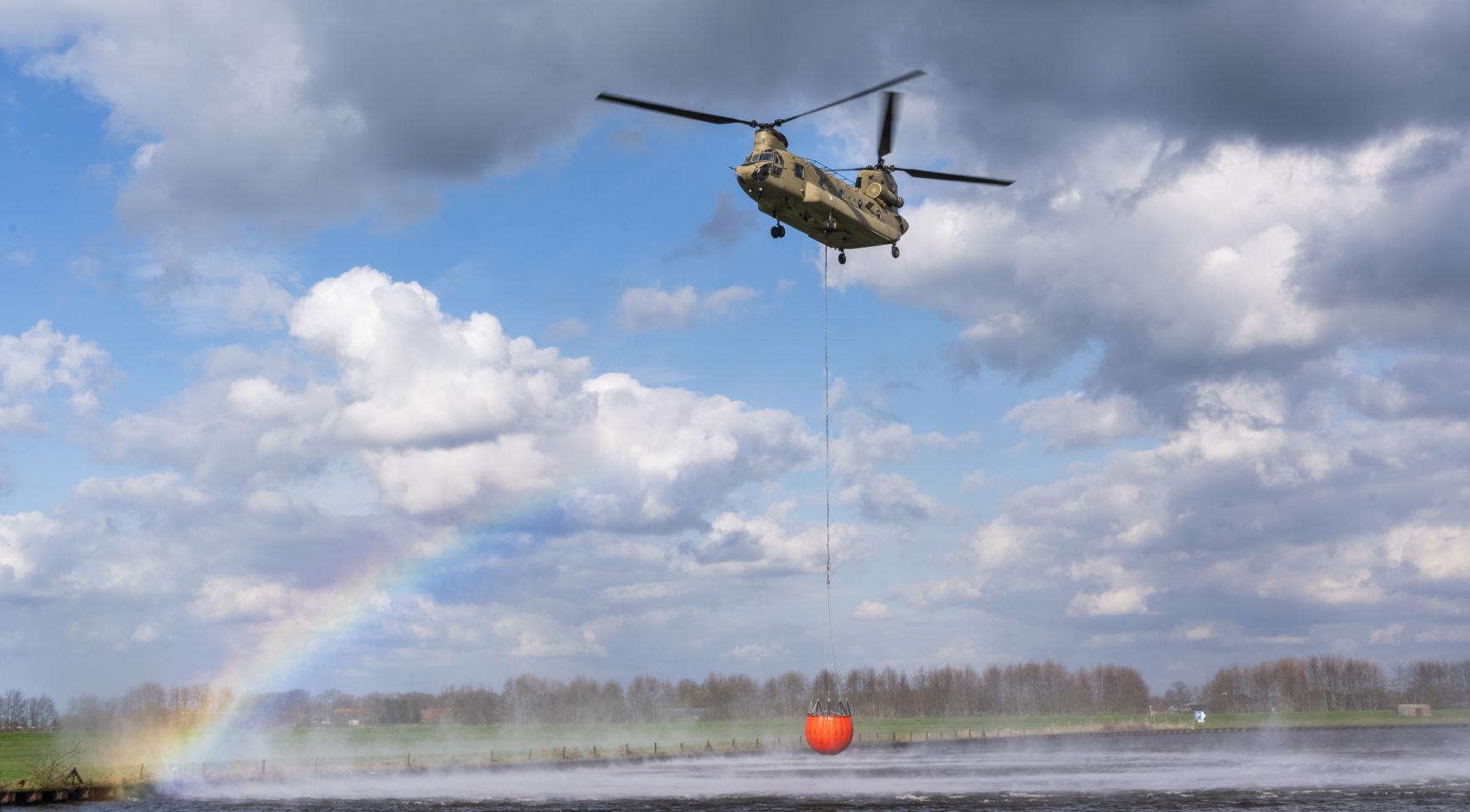
The issue came into sharp focus on April 3, when a Chinook helicopter dropped 7,600 liters of water at a time to help extinguish a massive heath fire on the Ginkelse Heide near Ede. The blaze destroyed 76 hectares of land. But such military assistance is no longer guaranteed, officials warn.
Defense support with helicopters has traditionally been a given. It is part of one of the Dutch military’s three main tasks. However, that role is under pressure. As global tensions escalate, the armed forces are shifting their focus more narrowly to national defense.
“What if that threat becomes reality? Then we’ll be left empty-handed,” Christiaan Velthausz, team leader of Fire Bucket Operations, the unit within the Dutch fire service that works with military firefighting helicopters, told Omroep Gelderland. Coordination of these operations has historically been the responsibility of the Veiligheidsregio Noord- en Oost-Gelderland (VNOG).
“We’ve seen a rise in helicopter deployments in recent years,” Velthausz added. “Due to climate change, wildfires are becoming more intense. Helicopters are a crucial weapon in those situations.”
In response, VNOG is exploring alternatives. “We are cautiously examining whether we could operate our own firefighting helicopters,” Velthausz told Omroep Gelderland. “But that is very expensive and would require a whole new organizational structure within the fire service. We would never make that decision lightly.”
Other options remain under consideration. “We’re looking at possibilities for cooperation within Europe. France has an entire fleet of aircraft specifically for fighting wildfires,” he added. “We could also consider using private contractors. Everything is still on the table.”
Currently, the Dutch fire service does not have its own helicopters and relies entirely on the military. The Ministry of Defense has 15 Chinooks, which are primarily intended for military operations. In the past, the fire service could also use Cougars, but those are no longer available.
When firefighting helicopter support is needed, local fire services must submit an official request to the military. Defense then provides both the aircraft and a two-person crew consisting of a pilot and a loadmaster, who operates the large water bag. The fire service’s own heliteam coordinates with ground crews to determine how the helicopter can assist.
Helicopters are typically deployed for fires in hard-to-reach areas, uncontrollable fires, or blazes that would otherwise take more than three days to extinguish.
The concerns raised by VNOG are not unfounded. Just two months ago, the Algemene Rekenkamer (Netherlands Court of Audit) criticized the Defense Ministry for lacking transparency in how it allocates its limited resources across its three main tasks. The report emphasized that the emergency services remain completely dependent on the military for disaster response and emergency assistance.
The issue of shrinking defense capacity is not limited to helicopters. Emergency management agencies collaborate closely with the military in many areas, prompting the national Veiligheidsberaad (Safety Council) to put the topic high on its agenda. “We want clarity about the consequences of losing that third core task,” a spokesperson said. “We need to understand what Defense will no longer be able to provide — and what we need to prepare for.”
Major Lucien, head of the Defense Helicopter Command, acknowledged the seriousness of those concerns. “They are very real for the future,” he told Omroep Gelderland. “We will always try to provide support when we can. At this time, we still guarantee capacity during the summer.”
Interim Defense Minister Brekelmans previously informed the Tweede Kamer that it would be wise for regional safety authorities to prepare for scenarios in which military resources may be limited or unavailable. “In the event of a conflict, it's sensible to assume that Defense capabilities may be restricted or (temporarily) unavailable,” he wrote. Brekelmans reportedly plans to meet with the Safety Council in early September to discuss whether certain military responsibilities should be transferred to regional safety authorities.


