
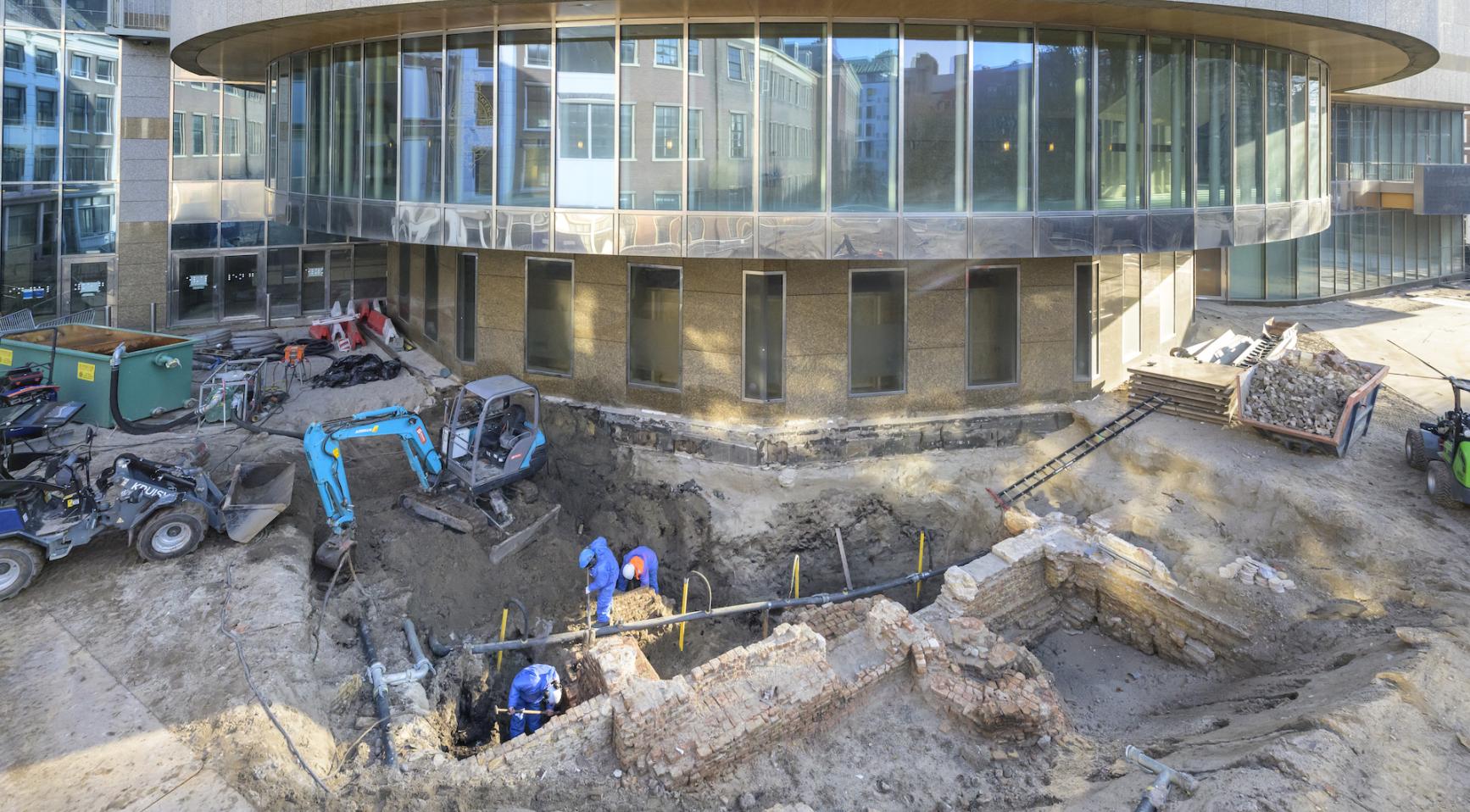
Archaeologists uncover more of 13th century city gate in The Hague below Parliament
Archaeologists working at the Binnenhof in The Hague have uncovered the foundations of the Spuipoort, a medieval city gate dating from the late 13th or early 14th century, Binnenhof Renovatie reports. The discovery was made during renovation work near the Tweede Kamer building and reveals previously hidden remnants of the historic entrance to the Binnenhof. The newly found foundations will eventually be incorporated into the redesigned public entrance of the Tweede Kamer.
The Spuipoort, originally built around 1352, served as one of the main accesses to the Binnenhof. The gate consisted of two slender towers with a central archway and was part of a complex system of double moats and gates surrounding the estate.
In the 15th century, the two original round towers were replaced with octagonal towers constructed on the existing foundations. Over the centuries, the structure underwent multiple renovations before being demolished in 1861. The underlying foundations remained intact and were now rediscovered.
Peter Stokkel, an archaeologist involved in the excavation, said, “The Binnenhof was where the power was, so only the elite came under the gate. Not everyone was allowed inside.” He added that the medieval brickwork, known as kloostermoppen, must be handled carefully. “With a scan, we know exactly which brick goes where, and it will be placed back in the new entrance.”
Andjelko Pavlovic, an archaeologist with the city of The Hague, said, “This discovery sheds new light on the rich history of the Binnenhof. Thanks to new technologies like 3D scanning, we can study these remains in ways that were previously impossible. After 33 years since the last significant excavation, we now have the opportunity to learn more about how the gate changed over time.”
Previous archaeological investigations in 1987 revealed portions of the Spuipoort during the construction of the current Tweede Kamer building. The ongoing Binnenhof renovation provides another chance to examine and preserve this medieval heritage, with plans to make the foundations visible in the new entrance once construction is complete.


