
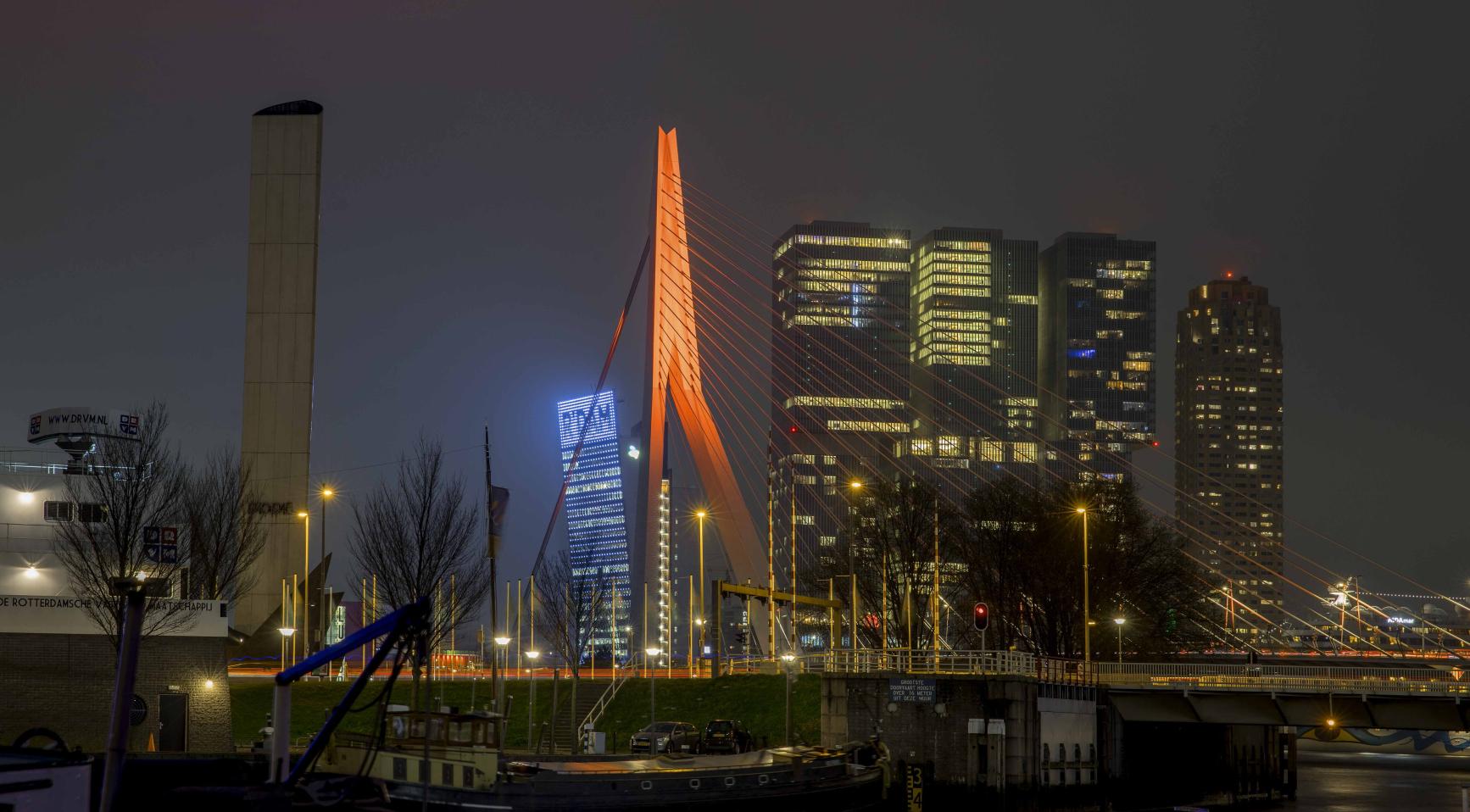
Orange buildings a statement about violence against women, not the World Cup
Many buildings were lit up in orange on Friday evening in several places in the Netherlands. The use of color has nothing to do with the World Cup in Qatar, where the Dutch national team played their second group match at the end of the afternoon. Instead, it was part of a global protest against violence against women. Called "Orange the World", the annual international demonstration is organized in about a hundred countries.
Five women worldwide are murdered every hour by a partner or a family member, according to the Orange the World organizer, UN Women. In the Netherlands, a woman dies in this way on average once every eight days.
In Rotterdam, the Erasmus Bridge, KPN's head office, De Doelen theater and the Erasmus MC hospital were among the buildings to be lit orange on Friday. A documentary about violence against women was also slated to premiere in KINO Rotterdam, with Mariëtte Hamer, the government commissioner for transgressive behaviour, set to attend..
In Amsterdam, the Oosterdok public library was to be colored orange. The city halls of The Hague, Apeldoorn and Dordrecht and elsewhere will also be illuminated orange, as will the largest hunebed in the country, in Borger, Drenthe. The Grote Kerk in Breda and the Academy Building of the University of Groningen were also going to be included in the demonstration. There are also buildings where special orange flags will fly in the coming weeks, and in Haarlem and the surrounding area, forty statues will be given an orange scarf.
The color orange stands for "a rising sun, dawn of a world without violence against women", explains director Marije Cornelissen of the Dutch organizer, UN Women Netherlands. The campaign was scheduled to start on Friday because 25 November is the International Day for the Elimination of Violence against Women. As such, there was little interest in postponing the symbolic statement to another date.
The fact that the orange campaign coincides with the World Cup can be both a disadvantage and an advantage, according to Cornelissen. "It helps to raise attention to it. Violence against women increases enormously during major sporting events. In England, the number of reports of domestic violence rises by 38 percent if the national team loses. In Colombia, there are more reports of a crime when there's a victory. Rising emotions and alcohol are a toxic combination."
The campaign will continue until December 10.
Reporting by ANP


