
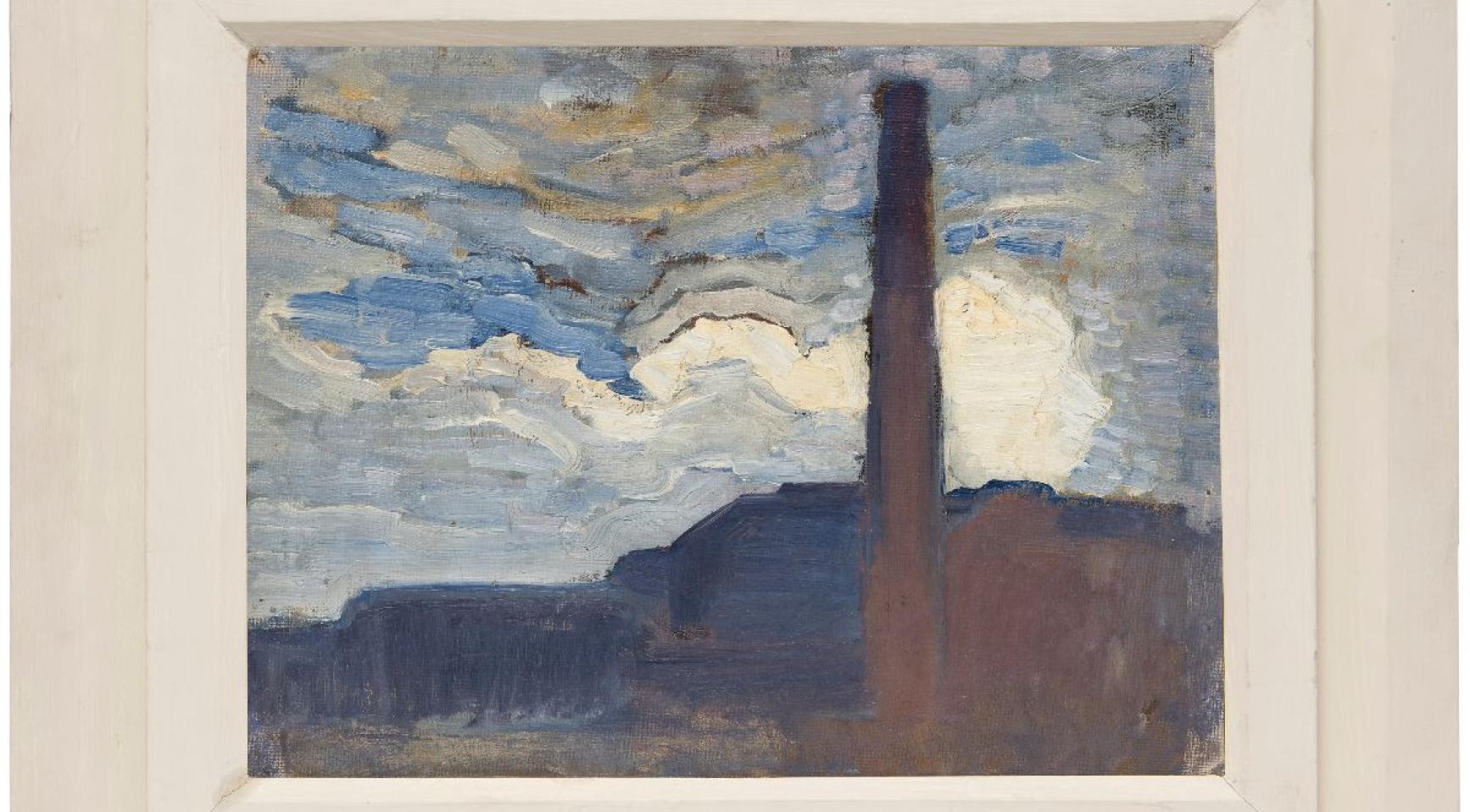
Singer Laren museum acquires previously unknown painting by Piet Mondriaan
Singer Laren has acquired a previously unknown painting by Piet Mondriaan that has been hidden from public view for over a century, the museum announced this week. The painting in question is titled Smokestack from circa 1908. It likely depicts the silhouette of the former Amsterdam Wax Candle Factory against a moonlit, cloudy sky and is considered a transitional work to Mondriaan’s famous minimal, abstract style.
According to the museum, Mondriaan expert Wietse Coppes of the Netherlands Institute for Art History (RDK) convincingly attributed the work to Mondriaan based on its provenance, technique, and style.
“The work exudes Mondriaan’s innovative spirit,” the museum said. “The simplified forms, vibrant color, and tense composition mark his development in the pivotal year of 1908, when he emerged as one of the leading modern painters in the Netherlands.”
The painting was last publicly displayed at the Stedelijk Museum Amsterdam in 1909. Gustaaf Adolf Ootmaar, a pediatrician from Haarlem, bought the piece and took it with him when he emigrated to Canada in 1922. The work was rediscovered a few months ago, still in the possession of Ootmar’s descendants in Canada.
“Through Coppes, Singer Laren came into contact with the family and was given the unique opportunity to acquire the painting,” the museum said. It called the acquisition of Smokestack “the fulfillment of a long-cherished dream.”
“The museum has been striving for years to acquire a representative work from Mondriaan’s modernist period. The work forms a crucial link in the presentation of Dutch modernism of the fin-de-siècle in the Nardinc galleries, where it connects tradition and innovation, and between Mondrian and his ultramodern contemporaries Sluijters and Gestel,” the museum said.
The painting will be on display in Singer Laren until February 8 next year, after which it will be temporarily unavailable for research into its background and condition. Afterward, it will be placed in Singer Laren’s permanent collection.
The museum did not say how much it paid for the painting, but did say that the acquisition was made possible with the support of the Friends of Singer Laren Foundation and the Hendrik Muller Fund.


