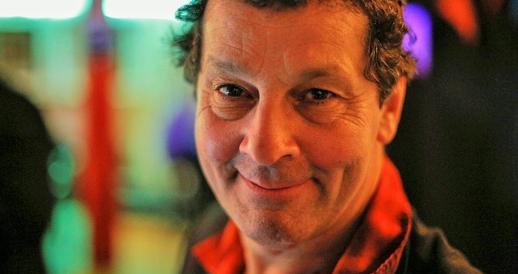
Director Marc Isaacs on his "scripted" IDFA film & the myth of purity in documentaries
British filmmaker Marc Isaacs has spent his career challenging the conventions of documentary cinema, but his latest film, Synthetic Sincerity, takes that provocation a step further. Currently in competition at the International Documentary Film Festival Amsterdam (IDFA), the feature-length documentary blends scripted scenes with real-life subjects to question the very nature of truth in an era of Artificial Intelligence. Nominated for a BAFTA for his 2001 documentary, Lift, Isaacs argues that the of traditional observational filmmaking is often just an illusion.
"It's not necessarily a criticism," he told the Dam Yankee podcast before his film's world premiere at the Amsterdam festival. Discussing one of the first motion pictures on record, Isaacs pointed out that the 1895 short film, Workers Leaving The Lumière Factory in Lyon, was staged despite being presented as authentic. "So I think from the very beginnings of the form, this kind of question of how one constructs an image has been there. And soon after that, had Nanook of the North, which was completely staged, you know. So yeah, we're just continuing the tradition, I think."
His new IDFA contender explores a premise where an AI lab at a fictionalized university in England licenses the footage of earlier films by Isaacs to train their systems to AI generate more realistic human characters. "And the people that work there, they all work in AI, but they have nothing to do with character analysis and making synthetic characters," Isaacs said to Dam Yankee host Zack Newmark. "So we wrote the script for them. You know, it's pretty improvised, things were written down, but they could go off on their own tangents."
But this hybrid style presents just as much truth, if not more, than documentaries that manufacture an artificial sense of connection, leaving the audience isolated from their own critical judgment. "If you watch a kind of classic Netflix documentary, it starts off very explicit with what this story is gonna be. There's usually very overpowering music to really bash over your head how you should be feeling. It's all so unsubtle, isn't it?" he said.
It is not particularly different when it comes to more artistic and less conventional films than those on the most popular streaming services. "You know, how do you how does one think about construction in documentary anyway? What about the all the other films?" he asked. "As soon as you turn up with a camera, you know we now are talking to each other, very conscious that we're also being filmed and we're performing in some way," Isaacs explained. "I think these debates have been there from the beginning, really, and I think they just never really go away."
Isaacs very much explores what he knows and what he wants to understand. Certain themes come up again and again, like loneliness, isolation, life in London, and building human connections through sharing food. "A lot of my early films were explicitly about, in a sense, questions of transience. We're born, we live, we die," he explained. His 2001 film, Lift, is entirely made up of interactions he and his camera had with people in a London high-rise apartment building. The elevator car is "a non-space" where people are in a type of limbo where they "are not in their lives and they haven't returned back to their lives. They're in this elevator suspended in time, which is a transient kind of space where you're neither even either you haven't arrived anywhere."
In many ways, Synthetic Sincerity continues to explore these themes, and ideas of self, home, and personal history. Isaacs convinces the lab workers to try to create an AI representation of an Uyghur man running a local restaurant in his neighborhood to give a voice to personal issues and traumas the man is not permitted to discuss. The Uyghur man is real, and Isaacs said he really was drawn to him because of his appearance. "It seems to me that his face hides so much. He has a quite beautiful face, but then you think about all the pain that he must have been through to kind of just leave his homeland and start a whole life here."
One issue Isaacs repeatedly faced in his career is that broadcasters have slashed their funding for documentaries, and commissioning editors at the broadcasters no longer have the independence to support projects as financial decision-making has been handed over to executives. "You would have chats with commissioners who controlled their own money," which would get the ball rolling on a new project.
"They give you bit of development money, you come back a few months later with some rushes, show them some material, and then they would sign off on the project. And that whole system changed where commissioners no longer had the power to actually commission anything. Everything had to go up to one person."
The end result is that most of the documentaries that wind up on streaming services are "very formulaic" as only cookie-cutter projects that can be scripted wind up getting funding. "And I've always made films that are a total discovery, starting off with some vague ideas and making the film up as I go along, which I still do in that way."
Tickets for the remaining screenings of Synthetic Sincerity are available on the IDFA website, and Isaacs will find out Thursday night whether his film takes the top prize in the International Competition section of the world-renowned festival. The film will then tour a festival circuit before it is potentially acquired for broadcast and online presentation.
His previous work is available on a variety of streaming services, and Isaacs releases updates about his film work and upcoming projects on his Instagram account. Listen to this entire episode of Dam Yankee on all major podcast platforms, or watch the full videos on YouTube.