
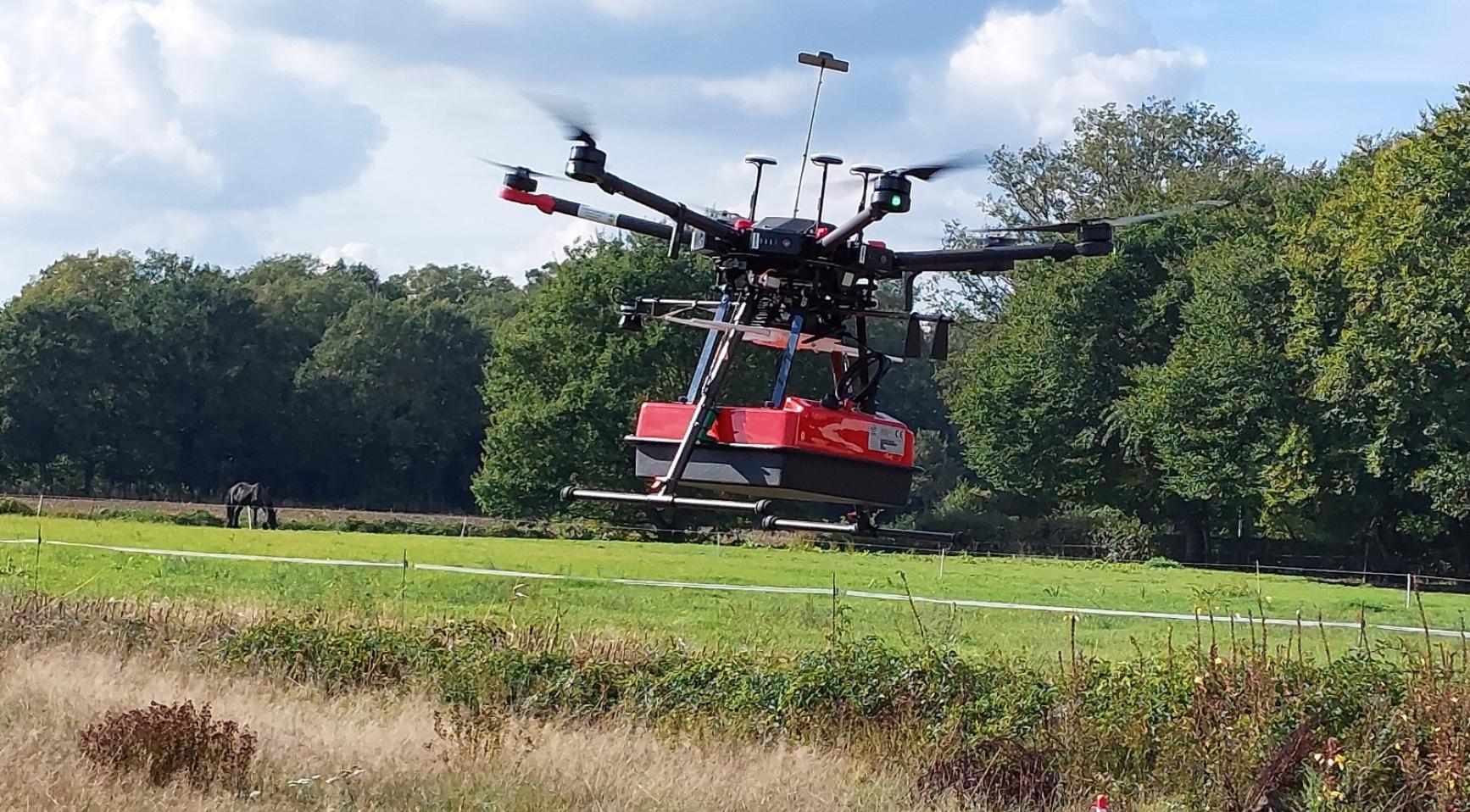
New Dutch drone can find hidden graves and buried bodies
An autonomous drone developed at Saxion University of Applied Sciences in Deventer is set to revolutionize crime scene investigation. The CSI-Drone is able to comb a large area to track buried corpses or hidden graves, using sensors to gather and analyze data about heat, soil composition, and the color of the vegetation to locate bodies.
Abeje Yenehun Mersha, professor of Unmanned Robotic Systems at Saxion and coordinator of the project, told NL Times that the project started following the disappearance of 25-year-old Anne Faber in 2017. The missing woman was found dead in the woods in Zeewolde after two weeks of searches, and was only found after police obtained a confession from a suspect who guided them to her whereabouts.
Mersha explained that people at the time used the traditional method of forming a human line to systematically comb a wooded area with sticks. “This takes a lot of time, energy, and resources.”
According to the professor, another problem with this method is that there is a risk that forensic evidence can be lost when a large number of people are involved in volunteer search services. They "unconsciously" destroyed forensic clues when they hiked through a potential crime scene, sweeping with sticks to find something that doesn't fit.
“So we thought it could be better,” he remarked. Over the past two years, his research group, police, companies, and public organization came together to combine their knowledge and come up with an innovative solution. “A drone is by far better than 100 people with a stick.”
They developed an autonomous drone that can scan a large selected area and look for forensic cues. Equipped with a thermal camera, ground-penetrating radar (GPR), and a hyperspectral camera, the drone uses sensors to collect data that will be analyzed to detect and localize the area that needs to be searched.
Mersha explained that the thermal camera can easily detect a freshly buried human because of the heat it emits. But locating a body that has been buried for a prolonged period becomes challenging due to the drop in body temperature. To solve this issue, the drone is equipped with a GPR camera that can recognize disruptions in the soil, indicating a possible burial site.
“If a cadaver is buried, the sensor will detect that something is abnormal,” Mersha stated. Another sensor, the hyperspectral camera, can localize cadavers or hidden graves by looking at color changes in vegetation. “The colors will be different,” a phenomenon attributed to the natural decomposition of the body, Mersha said.
He added he is confident his drone will facilitate search crime scene investigation in the future. “As a supporting tool, not a replacement.” He said that “We have shown the applicability of the technology. But it’s not a product yet.” He explained that certifications and specific protocols need to be established before the drone can be deployed. “But that's not our job, we only show the way,” he noted.
The professor is optimistic about the increasing relevance of drones in the future. "Today it’s easy for people to think about the use of drones for military purposes. But we should consider their potential for civilian application,” he suggested. "It has a lot of potential." Mersha pointed out several other practical uses for drones, such as cleaning windows on high buildings, inspecting wind turbines, or combatting fires.
“They will become indispensable in the future,” he concluded.


