
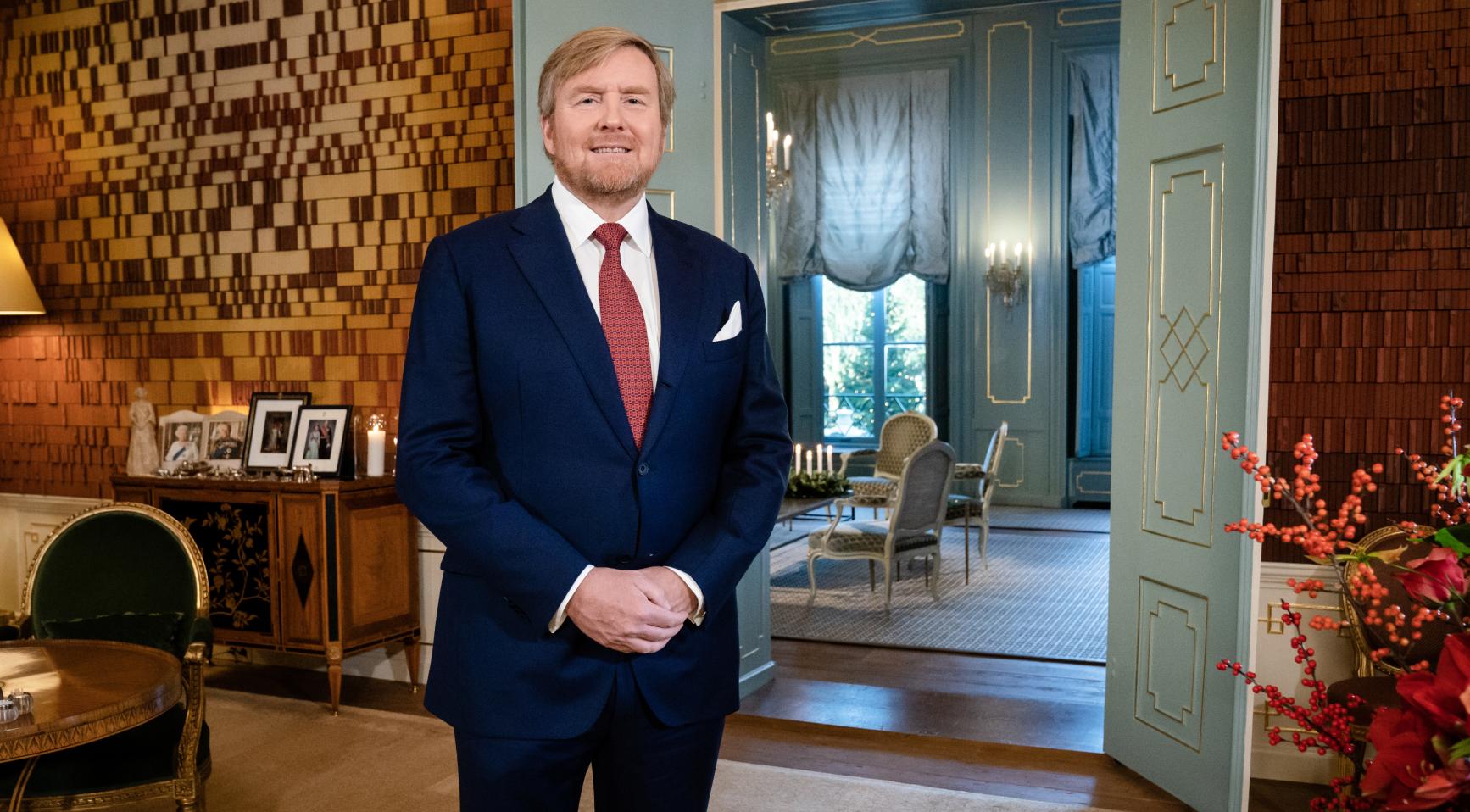
Full text in English of King Willem-Alexander's 2022 Christmas speech
NL Times produced an English translation of King Willem-Alexander’s speech on Christmas Day, and also published an article summarizing the key portions of his annual televised address to the people of the Netherlands. It was his tenth such Christmas speech since ascending to the throne in April 2013.
Many of you are under a shadow of worry this Christmas. “It's a tough time,” people tell me. Is there enough money to pay the bills now that everything has become so expensive? Where can I finally find a suitable home or a student room? And what about the future of my company?
It is also a confrontational time, because isn’t climate change forcing us to make drastic choices? And are we not running up against restrictions in our country with its limited space and conflicting interests? We can feel it in our bones that we can no longer postpone difficult decisions. Patches and emergency bandages no longer help. It has to be different.
That confronts us with the question of where we want to go from here. What kind of society do we really want, and how do we hold on to our values - freedom, equality, social justice - on the way to a new stability?
Very complicated! I understand the uncertainty that can be felt in many places, the stress and also the anger. It can then be a relief to let off some steam. But we must not get bogged down in scapegoating and cynical criticism or indifference.
Democracy does not mean that those who shout the loudest get their way. Democracy means working together on solutions that the majority can identify with while respecting everyone's fundamental rights. This involves careful consideration of all interests.
The latter is essential, for example in the relationship between rural and urban areas. It is high time to strengthen the connection. Because what would the Randstad be without the provincial regions? And the provincial regions without the Randstad? We desperately need each other.
Let's try – wherever we live – to escape prejudice. Let's make sure we do not lose hold of each other! At least give each other the benefit of the doubt. My call to each and every one of you is: join in, listen in, think along, take part!
Sometimes it can help to look outward and draw on the example of others. Like the Ukrainian people who for ten months now have been standing up with incredible courage and unity against the brutal violence by Russia. The promise of Christmas – the hope of peace – lives in all Ukrainian hearts, and in ours.
The wisdom of the elderly can also provide inspiration. I am reminded of Gratitude, a short book by neurologist Oliver Sacks, written towards the end of his life. It made him happy to see young, talented people all around him. “The future is in good hands,” he writes.
"The future is in good hands." I'd like to tell him. I meet them everywhere. Young people with ideals and imagination. They feel jointly responsible and are prepared to take the future on their shoulders.
There is so much resilience in the young generation! But young people cannot do it alone. They rightly say, “Don't put it all on us. Listen to us, give us space, trust us, help us, but take personal responsibility and live up to it.”
We don't always realize it, but we are capable of so much more than we think. I am convinced that we can also successfully conclude very complex problems and heal painful wounds, so that we can move forward together. Even when there are intense emotions involved.
An important example of this is the acknowledgment of the suffering inflicted on people during the colonial era.
Over the past year, my wife and I have spoken to people of all ages about this topic, including descendants of people who lived in slavery several generations ago. In the upcoming commemorative year, this will keep our focus. We will remain involved.
No one now is to blame for the inhumane acts that were perpetrated on the lives of men, women and children. But by honestly facing our shared past and acknowledging the crime against humanity that was slavery, we are laying the foundations for a shared future.
A future in which we stand against all contemporary forms of discrimination, exploitation and injustice.
The apologies offered by the Cabinet are the beginning of a long road. Let's keep holding on to each other, even in intense times with strong emotions.
Marieke Lucas Rijneveld wrote her own poem when, after a fuss, he decided against translating The Hill We Climb after some commotion. It is called Alles bewoonbaar. A combination of empathy, hope and belief in our future together.
These are the last lines:
Jij wil juist verbroedering, je wil één vuist, en wellicht is je hand
nu nog niet krachtig genoeg, of moet je eerst die van de ander
vastpakken om te verzoenen, moet je daadwerkelijk de hoop voelen
dat je iets doet wat de wereld zal verbeteren, al moet je dit niet
vergeten: kom na het knielen weer overeind en recht samen de rug.
I wish you all – wherever you are and whatever your personal circumstances – a blessed Christmas celebration.
Editor’s note
The poet, Marieke Lucas Rijneveld, who became the first Dutch winner of the International Booker Prize in 2020, was initially asked to translate Amanda Gorman’s poem The Hill We Climb, which she recited at the 2021 inauguration of U.S. President Joe Biden. Instead, Rijneveld composed his own poem, Alles bewoonbaar, or Everything Inhabitable. The portion cited by Willem-Alexander was translated by Michele Hutchinson as:
what you want is fraternity, you want one fist, and maybe your
hand isn’t yet powerful enough, or maybe you should first take the hand
of another in reconciliation, you actively need to feel the hope that
you are doing something to improve the world, though you mustn’t
forget this: stand up again after kneeling and straighten together our backs.
An English translation was published by The Guardian.


