
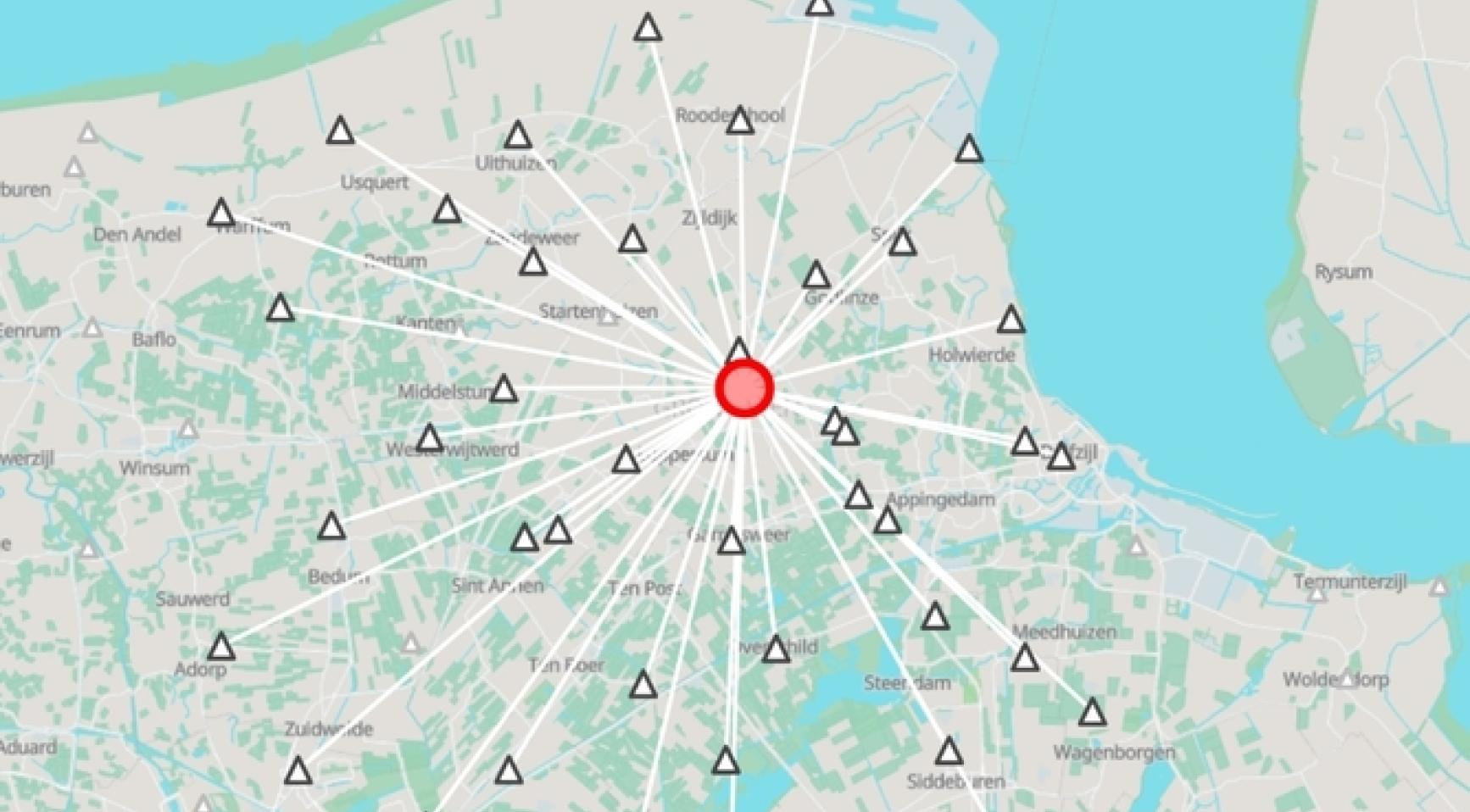
3.4 magnitude earthquake near Delfzijl; Third strongest quake in Groningen history
A magnitude 3.4 earthquake struck Groningen province overnight. According to the meteorological institute KNMI, this is the third-strongest earthquake ever recorded in the province. The KNMI called it an “induced earthquake,” meaning it was caused by decades of gas extraction in Groningen.
The earthquake struck at 1:16 a.m. near Zeerijp, 10 kilometers west of Delfzijl. It was felt across a large part of the province. At 6:39 a.m., an aftershock of magnitude 2 was recorded. So far, nothing is known about damages.
RTV Noord received hundreds of reports on its earthquake alarm system. Jasper Jacobs from Zeerijp told the broadcaster that the quake startled him awake. “It was a real shock. It was a terribly loud bang. We’d never experienced anything like it before.”
Debora Veldman from ‘t Zandt had just finished feeding her 3-month-old baby when the earthquake hit. "All sorts of things fell over in our house, and the lights outside, which normally only respond to movement, came on. It was terrifying. When you're holding a baby like that, it's incredibly frightening."
Max Siccama was driving at the time of the quake. “I lost my grip on the road twice due to two large tremors.”
“The earthquake was felt from the German border to the Drenthe border,” said Daniel Theelen, the reporter who handles gas extraction-related reporting at RTV Noord. “There was hope in Groningen that stopping gas extraction would eliminate major earthquakes. That’s why last night’s impact was not only physically, but also mentally severe.”
The last major earthquake in Groningen was in Westerwijtwerd in 2019 and also had a magnitude of 3.4, but was slightly weaker than last night’s. The strongest earthquake hit Huizinge on 16 August 2012 with a magnitude of 3.6. The second strongest quake was a 3.5 magnitude in Westeremden on 8 August 2006. Last year, there were six earthquakes in Groningen with a magnitude of 1.5 or higher - the level at which earthquakes can be felt.
The earthquakes in the province are caused by gas extraction, which started in the 1960s. The Groningen gas fields closed over two years ago, but earthquakes are still possible. “This is because there is still tension in the subsurface from the gas extraction,” KNMI seismologist Läslo Evers explained to NOS. “Every now and then, this tension is released by faults in the gas field; that is an earthquake.”


