
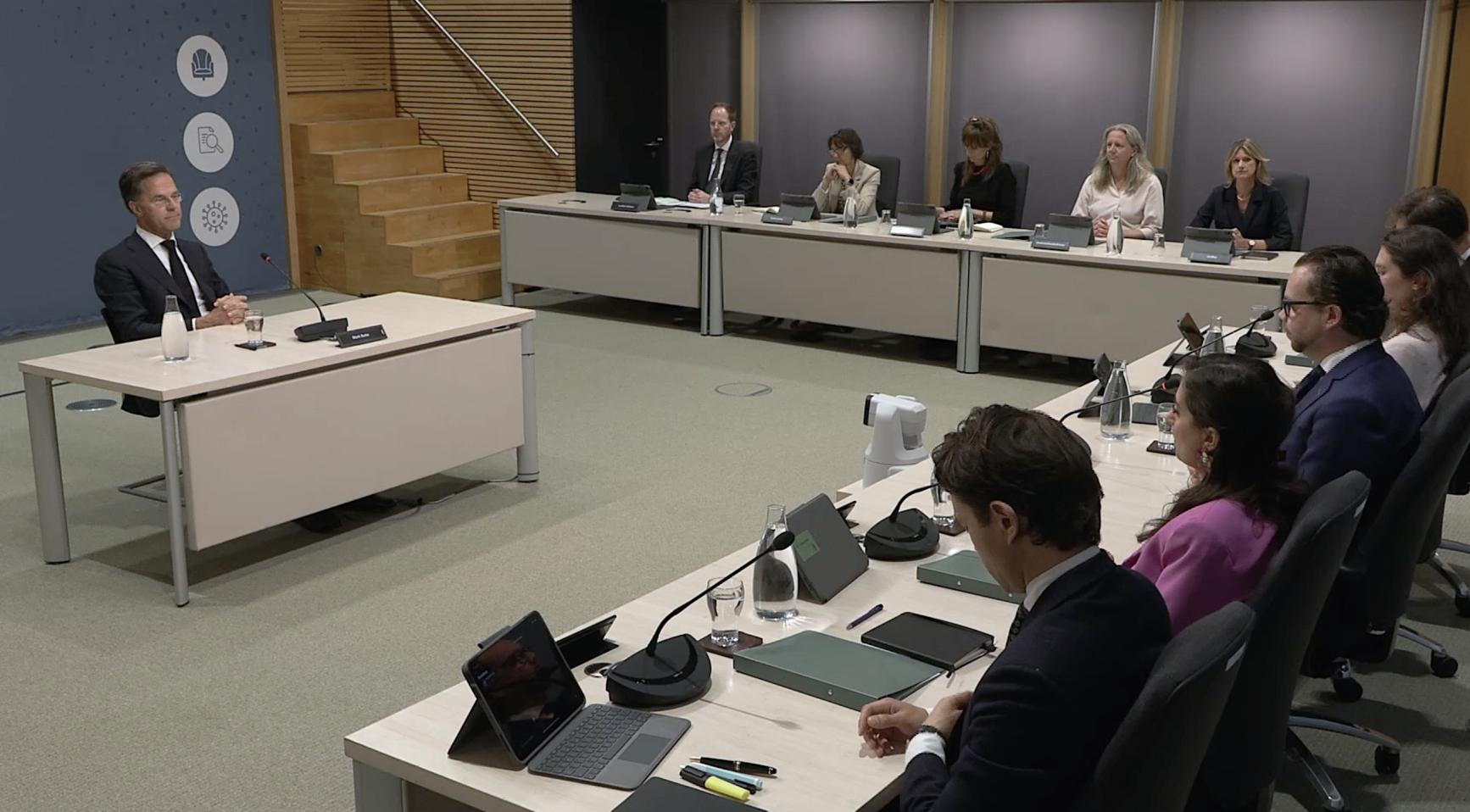
Former PM Rutte: Netherlands narrowly avoided “code black” during COVID-19 pandemic
Former Prime Minister Mark Rutte told the parliamentary inquiry committee on COVID-19 that the Netherlands narrowly avoided a collapse of hospital care during the pandemic. He said a “code black” situation was only just prevented, “also thanks to Germany.”
The ability to treat all patients requiring intensive care during the first COVID-19 wave in spring 2020 was partly due to support from Germany. In emergency situations, patients could be transferred to German hospitals, which had significantly more capacity for ventilator care.
Rutte told the parliamentary inquiry committee how relieved he felt after learning from the minister-president of the German state of North Rhine-Westphalia that such a transfer option existed. The expectation at the time was that up to 2,400 ICU beds would be needed in the short term, while Dutch capacity could only be scaled up to around 1,700 beds.
The former Prime Minister told the parliamentary inquiry committee on COVID-19 on Friday that the coronavirus crisis triggered “strong emotions” within the Cabinet, particularly during its early stages in spring 2020.
Rutte said he could not go into much detail because it concerns the confidentiality of those discussions, which he described as “not political, but deeply human.” He pointed in particular to periods when infections surged, and hospitals came under severe pressure. According to the former prime minister, those moments had a strong emotional impact on both the ministers involved and himself.
Rutte also said that the impact of the measures introduced to slow the spread of the virus was sometimes “overwhelming.” He stressed that it was therefore important to meet regularly and simply check in with one another by asking, “How are you doing?” According to him, meetings such as the Torentjesoverleg helped provide that space.
The former prime minister acknowledged that, as the crisis continued, the measures increasingly caused tensions within the Cabinet. He added that occasional disagreements or clashes were not an issue for him: “They are politicians, they are supposed to clash.”
Rutte said the Cabinet was expected to present a unified position. Without mentioning her by name, he referred to the dismissal of then State Secretary Mona Keijzer in September 2021, after she publicly criticised the government’s COVID-19 policy in an interview.
Rutte described the advice of the Outbreak Management Team (OMT) during the coronavirus crisis as “sacred,” but later told the parliamentary inquiry committee on COVID-19 that this was not a well-chosen term. OMT members Jaap van Dissel, Jan Kluytmans, and Marion Koopmans indicated during their own hearings that Rutte tended to assign too much weight to the advisory group’s role.
“I fully understand Van Dissel, but that is not how it was,” Rutte said. According to him, the OMT advice on the policy direction was “leading,” but “not decisive.” It was always a political choice, with the cabinet also making other considerations alongside the OMT advice, Rutte said.
Rutte stressed that the OMT’s medical assessment was so severe that there was effectively no scope for relaxing measures, as this would have endangered the objective of preventing a “code black” scenario.
Rutte’s next hearing is scheduled for after the summer. It is the third parliamentary inquiry in which the former prime minister will be heard under oath. He was previously questioned in investigations into gas extraction in Groningen and the controversial handling of fraud cases involving childcare benefits and other social benefits.
Reporting by ANP


