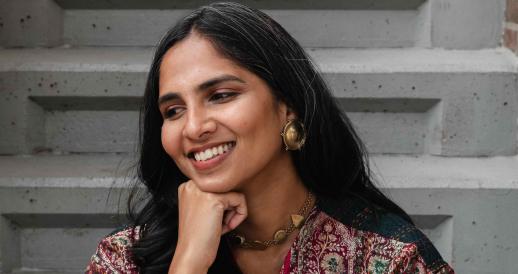
Award-winning Ukrainian artist Daria Khozai unpacks trauma and the concept of home
Inspired by the potent symbolism of a childhood Soviet-era cabinet wall, Ukrainian artist and architect Daria Khozai's award-winning installation "If Walls Could Talk" offers a powerful exploration of traumatic memory. Now based in Amsterdam, Khozai's work, which earned her the 2025 Galatea Kunstprijs, challenges conventional understandings of trauma and memory by delving into how both individual and collective traumas intricately relate to the built environments. where they occurred.
The interdisciplinary artist and architect has been located in the Dutch capital for eight years. Along with her installations, she is simultaneously conducting self-initiated research on traumatic memory at the Amsterdam University Medical Center Department of Psychiatry. Her unique triad of disciplines have resulted in the fusing of craftsmanship, architectural research, and academic psychology, enabling Khozai to analyze the anatomy of trauma in a most unique manner.
Khozai received this year's Galatea Kunstprijs, awarded annually to artists with a refugee background. “If Walls Could Talk” is inspired by a Sovetskaja Stenka from her childhood home. This iconic cabinet wall full of porcelain, glittering crystal and propaganda books reflected the Soviet ideology of communism, censorship and complete state control. The embalmed mealworms on the installation symbolize the rot from within, she says. Her work, along with that of the four other nominees, can be viewed at the Dordrecht Museum until October 5.
Khozai sat down with the Dam Yankee Podcast, in partnership with NL Times, this week to discuss the success of her project. She also touched on what home means to her, if she will return to Ukraine, and what is it like to be an artist in the Netherlands.
Dam Yankee: When the war in Ukraine eventually does come to an end and if there is a call for the diaspora to come home, is that something that you would look towards?
Daria Khozai: Well, it's difficult to talk about it like this because today is the fourth of July and it was a horrible night in Kiev. So I, of course, I really feel for it, and I didn't sleep all night myself. So of course I want to come back, but I want to say, I want to be a bit realistic.
Ukraine has much more problems than just the war. We still have a lot of corruption. I really don't think this will change anytime soon, even after the war finishes. So I don't see too many possibilities for myself because I'm trained as a landscape architect. I have a big project that I would love to present there because I know Ukraine more than, for example, Norman Foster Company, who's to construct something there after the war finishes. I would like to contribute.
But I don't really see possibilities, at least not during my life. So yeah, I would like to come back. Of course, I would love to do something there professionally, yes. To live there—I don't think I can fit there anymore or something. I don't feel welcome there. Also in the professional field, the same like here, the same like anywhere—I feel like in between.
DY: Can you expand on that a little bit more—how you don't feel welcome when you go back to Ukraine?
DK: Well, first of all, I don't have too many people who stayed there. So now they are spread all over the world. Of course, I have my mother and my younger brother there. So yeah, of course I'm welcome there, but...
The art field there works a little bit differently. They have their own group of artists that they are really taking care of, and the young artists don't have really that many opportunities. I also heard it from the artists in the Netherlands that it's difficult to succeed in the country you're coming from because people are even more critical to what you do.
I also got comments that, yeah, how can you talk about this problem—you left, you know? But yeah, I didn't leave because I wanted to. So it's a bit strange. I also get comments because sometimes I can speak Russian, so I get comments on that as well. But if you comment on my language, how are you different from the Russian person that forbids speaking different languages in the country? We are multinational, and we should respect it also.
It's a bit controversial, especially now. People united at first and were very supportive. And now it's kind of the opposite. It feels like everybody's a bit against each other and even more critical, even more angry. Yeah. It's a difficult conversation.
DY: That division that you see and those sorts of divides you were just reflecting on—is that something that you've also noticed elsewhere as well?
DK: Yes, exactly. So I heard—because I don't have this experience—but I heard from Dutch artists in the Netherlands that it's also very difficult to succeed, just because people are more critical. They are more interested to see the stories from outside. And I want to say that I actually don't mind because everybody in Ukraine knows what's going on in Ukraine. Okay, my role is to show it here for the people who don't know enough or don't pay attention enough—to talk about it. To bring it to the table again.
For example, I was in the Dordecht Museum recently, and there was a group of tourists from the USA. I was really very happy and surprised to see that for them it was just like a touristic location—they just visited a museum. But then it really touched them, because maybe they never thought about migration in this way, from the point of view of the refugee who flees. So it also opened up something for the people who maybe were not even thinking about it before.
All of Daria's work and happenings can be experienced and followed on her website, and an impressive 360-degree reproduction of her piece, ‘Pravda’, has been made available to explore online.
Listen to this entire episode of Dam Yankee wherever you get your podcasts, or watch the full videos on YouTube. Daria goes on to explain how she uses art as a coping mechanism, why she will never make work for clients, and how so much of her life as an artist is just like any other job.