
Police: Journalists arrested amid terrorism threat at NATO protest
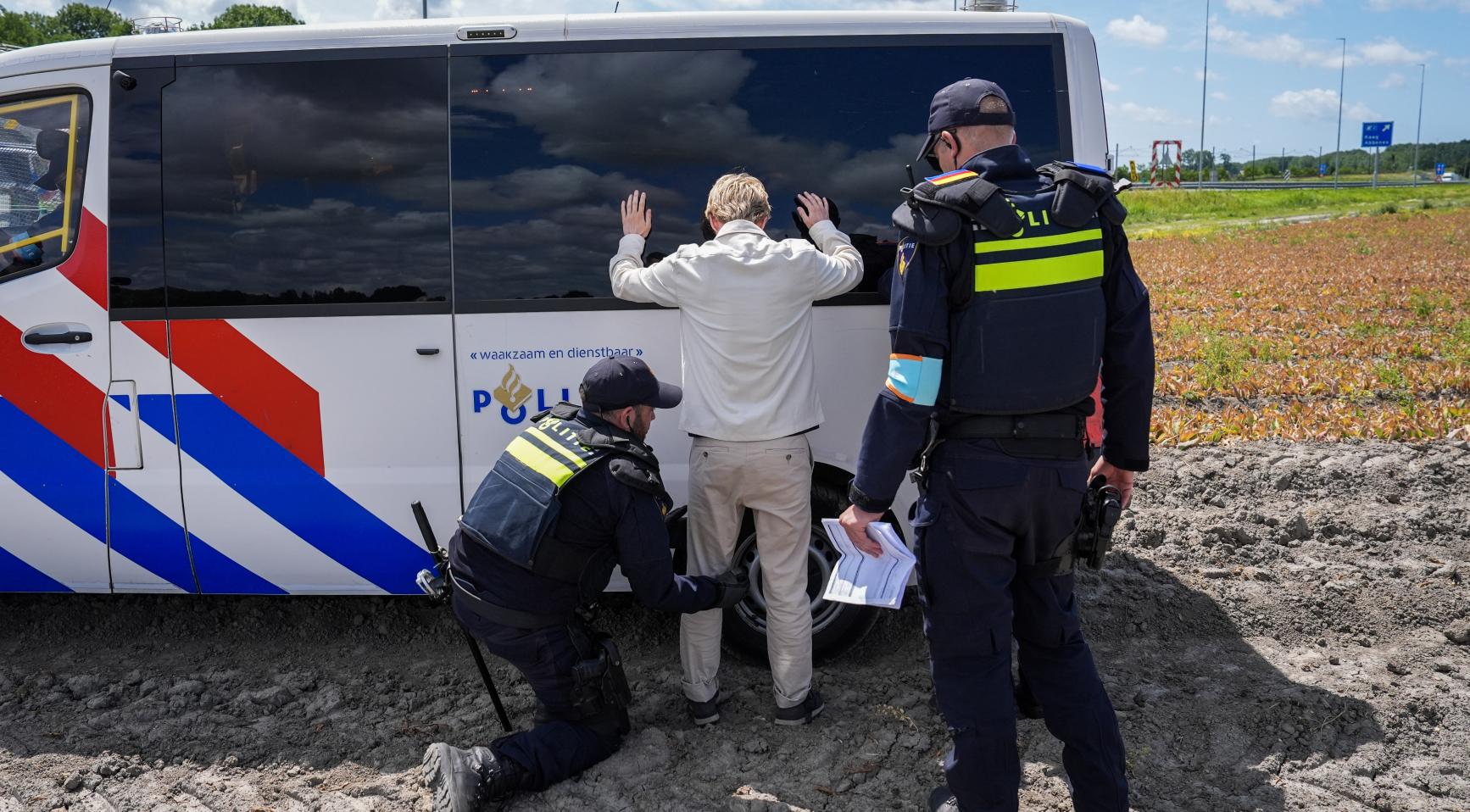
Two journalists from Leidsch Dagblad were arrested Monday while covering a demonstration by Extinction Rebellion (XR) near the A44 highway at Abbenes, Noord-Holland. Police said the reporters lacked the required police-issued press cards. Other journalists present, including from ANP, were ordered to leave the area under threat of arrest.
According to the municipality of Haarlemmermeer and the Noord-Holland police, the removals were based on an emergency order issued for the NATO summit, which explicitly bans demonstrations on or near the A44. XR had announced the action in advance, urging NATO member states to take urgent measures against the worsening climate.
Police had designated the protest site a security risk zone, citing an unspecified terrorism threat, though they did not disclose further details about the nature or source of that threat.
Before the protest began, two ANP reporters were stopped by officers. Police blocked their vehicle, demanded press cards and driver’s licenses, and photographed the car’s license plate. No explanation was provided for the photos.
The A44 toward The Hague has been closed to regular traffic ahead of the NATO summit and is reserved for summit delegations traveling from Schiphol Airport. Traffic heading in the opposite direction remains open.
Several dozen XR activists attempted to block the highway but were unable to reach it. The group gathered instead in a field beside the road, where they were surrounded by police. Officers ordered the demonstrators to disperse, but they refused. Police vehicles were stationed nearby, and a helicopter hovered overhead.
Protesters carried signs with slogans including “No safety on a dead planet” and “NATO leaders please behave.” Police had previously warned that highway blockades would not be tolerated. XR has also announced plans to block the A12 in The Hague on Wednesday, the day NATO leaders are scheduled to meet.
The arrests drew sharp criticism from press freedom advocates. “Police ordering journalists to leave and threatening them with arrest is exactly what we don’t want,” said Thomas Bruning, general secretary of the Dutch journalists’ union NVJ. “Journalists must be able to do their work.” He added that he was “surprised and alarmed” by the situation.
Peter ter Velde of PersVeilig, a Dutch press safety organization, also condemned the police actions. “The police must leave journalists in peace, also during the NATO summit,” Ter Velde said.
He stressed that reporters should be allowed to work freely as long as they can prove their professional status. “That can be done, for example, with a press card issued by the journalists’ association NVJ,” he said. “We now know that journalists are being taken away along with demonstrators and interrogated. That is not the way to treat journalists.”


